






About Robert L. Cattoi


Robert L. Cattoi was an engineer who loved literature. His family has made a donation to our lab in his memory, finding in the lab's celebration of both technology and literature a fitting parallel to Bob's own life. They share the following bio about our lab's namesake.
In 1950, Bob graduated with honors from the University of Wisconsin-Madison with a bachelor's degree in electrical engineering. He began work at Collins Radio (later Rockwell Collins), where he started as an engineer and ultimately advanced to Corporate Senior Vice President of Research, Engineering, and Manufacturing Processes. His work at Rockwell was largely focused on designing and guiding systems that made communication possible during flight, from aircraft electronics to the earliest technologies of space-based communication.
But even before Bob became an aerospace engineer, he had been interested in the mechanics of flight. When he was six years old, his father paid fifty cents to take him up in a Ford Trimotor plane at the Iron County Fair, and that started his lifelong fascination with aeronautics. During World War II, fresh out of high school, Bob served in the Army Air Corps. While he was stationed in Brownsville, Texas, he and his team rescued three submarine-hunting B-17s that were lost at sea by triangulating an increasingly faint signal and transmitting guidance to shore, saving the lives of all three crews.
This story tells us a lot about how Bob saw his work: that communication could save lives, and that every signal mattered, no matter how weak. His team took something as fragile as a dying radio signal and made it strong enough to bring people home. There’s a lot of technical expertise required to protect and enhance the clarity of that signal as it moves through noise, distance, and motion. But it’s working toward an incredibly human goal: bring people home. When we think about it that way, it shows us how deeply this work required a particular kind of care: for people, for the messages that we send to each other, and for the technologies that allow those messages to persist and endure.
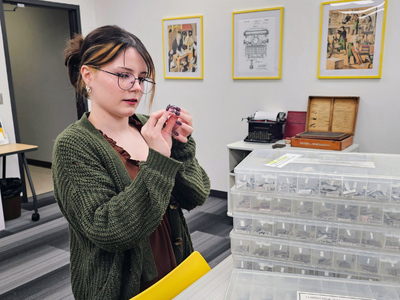
And that care really guided the rest of Bob’s career. He designed and patented a rotatable coaxial joint that keeps signals steady through mechanical motion (see if you can find his patent diagram in our lab!). He oversaw the development of high-frequency gallium arsenide circuits that sent signals faster and farther than ever before. And he helped to lead research into infrared detectors sensitive enough to capture light that had traveled billions of years through space.
These same technologies still connect us today: they are in our phones, our satellites, and even the telescopes that show us the birth of new galaxies. For Bob, this work was never just about circuitry or hardware. It was about communication. Language and technology were two sides of the same impulse in him to help humans share messages. That’s why it should be no surprise that Bob was also a voracious reader. (He was, in particular, a lover of Ogden Nash’s poetry and of a good detective novel.)
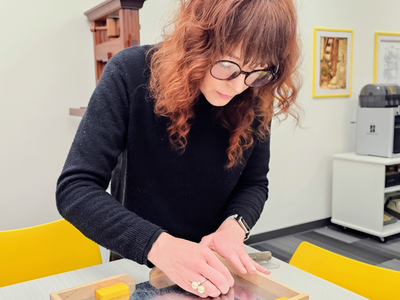
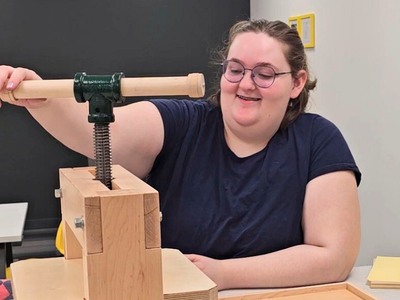
Bob’s family is honored to be able to support the creation of this lab because we think it's a space that is deeply fitting of his work. This lab is a place where old and new technologies meet: where a letterpress stands beside a 3D printer, where digital publishing software sits across from traditional bookbinding frames. From quills to code, this lab reminds us that every act of communication, whether it travels by ink, by signal, or even by infrared light, relies on technical precision and human interpretation working together. We hope that the Book Technologies Lab will continue Bob’s work of connection and communication and carry his signal forward.