

Strengthening Communication Instruction in IPE: A Study of Current Practices and Future Strategies
White Paper
On this page:
Executive Summary
Faculty at Wichita State University (WSU) implement interprofessional education (IPE) activities to allow students a safe environment to practice working in interdisciplinary healthcare teams. The goal of IPE is for students to practice communication skills and teamwork to improve patient safety and health outcomes. This White Paper aims to examine how IPE facilitators from WSU and the University of Kansas School of Medicine – Wichita (KUSM‑W) teach communication methods and skills through structured IPE activities, with the goal of informing instructional strategies that improve student communication practices. Current collaborative IPE activities include TeamSTEPPS I, II, and III, an Autism Interdisciplinary Diagnostic Team (AIDT), and participation in the National Case Study Competition with partner organizations. Additional activities are operationalized across WSU departments that include Friday Night at the ER and IPE didactic learning modules developed by the Shocker IPE team available to the College of Health Professions (CHP) faculty and students.
Communication is a hallmark of IPE and considered one of four Interprofessional Collaborative Practice (IPEC) Competencies along with Values and Ethics, Roles and Responsibilities, and Teams and Teamwork. While all competencies are critical to patient safety and outcomes, the ability to communicate effectively with patients and across professional teams represents a key opportunity for measurable instructional impact. One area for continued improvement identified by our team is to systematically develop C2: Using communication tools, techniques, and technologies to enhance team function, well‑being, and health outcomes. Activities allow students to fluidly experiment with communication methods, but facilitators do not consistently pair instructional best practices with evidence‑based research for improving communication at IPE events.
Drs. Amy Chesser, Amy Drassen Ham, and Nikki Keene Woods from the WSU Department of Public Health Sciences, in collaboration with the National Interprofessional Healthcare Education Applied Research Team (NIHEART), designed a study to learn more about Wichita IPE activities.1 NIHEART is an interdisciplinary faculty team dedicated to advancing interprofessional education, research, and practice in healthcare. The team supported the design, implementation, and analysis of this project. This White Paper is based on results gathered from Dr. Chesser’s key informant interviews (KII) conducted with IPE partners to specifically learn how Wichita facilitators teach communication methods and skills through planned IPE activities.2 The goal is to use this information to advance instructional strategies to improve student communication practices. The findings highlight the need for systematic integration of IPE communication education and the need for continued research and development of IPE communication best practices.
Background
WSU CHP has a rich history with IPE. In 2010, then Dean of CHP Peter Cohen launched the Health Professions Interprofessional Initiative charged with developing IPE across programs in CHP. The workgroup was comprised of a team of interprofessional faculty who met weekly to work on the challenge to implement an IPE strategy that would span lockstep and traditionally didactic programs. The workgroup birthed initiatives such as a paper-based IPE scenario involving the care of a veteran with severe head trauma and an in-class initiative where physician associate and public health students engaged in discussions based on the book The Immortal Life of Henrietta Lacks. In time, the paper-based IPE activity was expanded by Wichita facilitators to include students from the University of Kansas School of Medicine – Wichita (KUMC-W), but these activities were still in their infancy, informally connected, and conducted by faculty as service rather than as part of workload. The CHP Interprofessional Education Advisory Committee and the Shocker IPE groups developed by WSU faculty strongly committed to IPE, but lack of support through grants or buyouts presented significant sustainability issues to creating and embedding a culture of interprofessional practice and education in Wichita.
A formal WSU and University of Kansas – Kansas City (KU-KC) collaborative evolved by 2015 when faculty joined forces to write an IPE grant. The grant was not funded, but the collaborative decided to implement a program developed by the Department of Defense and the Agency for Healthcare Research and Quality (AHRQ) in 2006 called TeamSTEPPS. The program is a professionally facilitated, three-part “evidence-based set of teamwork tools, aimed at optimizing patient outcomes by improving communication and teamwork skills among healthcare teams, including patients and family caregivers.” KU-KC hosted the first TeamSTEPPS events and eventually included the WSU and KUSM-W campuses.
Core Wichita IPE Activies
- TeamSTEPPS I
- TeamSTEPPS II
- TeamSTEPPS III
- CLARION
- AIDT
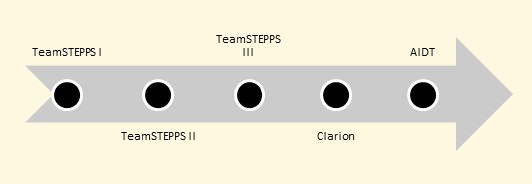
TeamSTEPPS I-III: Building Communication Skills Through Practice
TeamSTEPPS III is a small-group event that takes place at the KUMC-W Simulation Center where students practice IPE skills with standardized patients. This is a three-hour simulation event offered eight times a year. Students learn communication skills such as closing the loop, CUS, and patient-centered interprofessional communication.
Currently, KU-KC leads the TeamSTEPPS process. WSU and KUSM-W wait for KU-KC to update TeamSTEPPS facilitator guides and videos and WSU modifies the materials specifically for the WSU students. For TeamSTEPPS III students learn communication skills such as closing the loop, CUS and patient-centered interprofessional communication.
CLARION: National-Level Interprofessional Teamwork
WSU and KUSM-W have partnered on the CLARION National Case Competition since its inception. CLARION is a co-curricular, interprofessional experience for health professional students based upon the Institute of Medicine’s report “Six Aims for a New Healthcare System”. Students participate in CLARION by volunteering to be part of interprofessional teams that spend months together processing solutions to a complex case study. Interprofessional student teams analyze and present case studies at a local competition, and the winning Wichita team then travels to compete in the national CLARION competition in Minnesota.
CLARION emphasizes:
The focus of CLARION is the professional development of healthcare students and includes:
- leadership development
- teamwork and communication
- analytical and reasoning
- conflict resolution
- business and organizational practices
CLARION Participation and Student Learning
Participation in CLARION leads students to a more sophisticated understanding of the healthcare system in which they will practice. The organizational structure of the CLARION student team models the type of interprofessional equality and collaborative leadership needed to effectively solve current healthcare system challenges.
The interactions among students lead to critical learnings; the most prominent being that fundamental biases about other professions are firmly rooted before students enter the health professions workforce. Hence, the primary outcomes of student CLARION participation are for participants to develop an understanding and appreciation of the skills each profession brings to the healthcare team and to develop positive relationships that will extend into their professional careers.
Several collaborative WSU and KUSM-W teams have won prize monies by placing in the top three at the national CLARION competition.
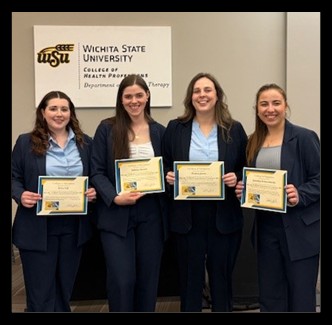
Student team: Sabrina Gooch (WSU Speech Language Pathology), Felicia Jones (KU Medical Doctor),
Erica Lill (WSU Nursing), Annalisa Schoenhoefer (WSU Health Management).
Photo credit: Jennifer Celso (WSU Physical Therapy).
AIDT Interdisciplinary Participation
Several disciplines also participate in the AIDT, initiated in spring 2012. Since that time, 133 students, clinical educators (CEs), faculty, and community professionals representing at least 10 different allied health and education disciplines have come together in a pre-professional, interdisciplinary applied experience where students and professionals provide diagnostic services for children who present with characteristics of autism spectrum disorders (ASD).
The activity is facilitated by IPE leaders who recruit students to participate in the diagnostic event, ensuring students from various professions are represented. Faculty and CEs supervising students participate in four diagnostic sessions each semester.
Wichita IPE Partner Institutions
Additional partner institutions engage in collaborative didactic IPE learning sessions, simulation, or other program-specific activities. In all, more than six institutions of higher learning participate in Wichita IPE activities ranging from didactic learning sessions to full simulation experiences.
Table 1. Wichita IPE Activity by Institution and Discipline
The following table lists the institutions, programs, and the specific disciplines that participate in each Wichita IPE activity.
The future of IPE development in Wichita includes the establishment of the Wichita Biomedical Campus (WBC), opening in 2027. The 470,000-square-foot WBC will house shared spaces for education programs, advanced laboratories, clinical research, and technology for three institutions – WSU, WSUTech, and KUSM-W. This transformational educational center will house 200 faculty who provide instruction for 3000 students from high-school concurrent healthcare education programs (CNA, CMA, HHA, LPN) through associate’s (RN, EMT, AAS), bachelor’s (BSN, BS), and master’s degrees (MSN, MHA, MPH, MPA), to doctoral degrees (MD, PharmD, DNP, DPT, PhD, DPT).
The high-tech facility will draw students, educators, and researchers from throughout the country to engage with our programs and clinical affiliate (Ascension Via Christi Wichita) to be part of this innovative and interprofessional educational experience. This facility will allow us to assess our current IPE activities and pioneer new methods for integrating teaching and learning about person-centered healthcare delivery with CNAs to PhDs.

Figure 2: NIHEART Logic Model
Interprofessional Education Communication Challenges
Interprofessional Education (IPE) communication challenges identified in the literature are multifaceted and deeply rooted in both structural and cultural aspects of healthcare education and practice. A recurring theme is the persistence of hierarchical dynamics within healthcare teams, which can inhibit open communication and collaboration among professionals from different disciplines (Lee & Doran, 2017). These hierarchies often lead to power imbalances, where certain voices—particularly those of nurses, allied health professionals, or students—may be undervalued or overlooked.
Additionally, logistical barriers such as scheduling conflicts, lack of shared physical space, and inconsistent institutional support further complicate the implementation of effective IPE communication training (Castillo et al., 2024; Buljac-Samardzic et al., 2020). Communication itself is described as a complex competency that extends beyond verbal exchanges to include active listening, adaptability, and situational awareness. Studies also highlight the lack of standardized evaluation tools to assess communication skills within IPE, making it difficult to measure progress or identify areas for improvement (Chen et al., 2019). These challenges underscore the need for intentional, well-supported IPE initiatives that prioritize communication as a core competency and address both interpersonal and systemic barriers to collaboration.
These challenges were supported through our interviews. Participants articulated logistical barriers, scheduling conflicts, lack of shared physical space, and inconsistent institutional and leadership support for IPE. Communication skills continue to be a multifaceted skill that emphasizes that “more is not better: better is better” (Marlow et al., 2018).
Interprofessional Education Communication Competencies
Effective IPE programs emphasize the importance of learning from, with, and about each healthcare profession to foster teamwork and improve patient outcomes. Key strategies include creating authentic and inclusive learning activities that simulate real-world clinical environments, allowing students from different health professions to engage in meaningful interactions. Additionally, the use of interprofessionalism behaviors and tools, such as behavioral assessments and teaching aids, supports the development of communication competencies across various healthcare disciplines and among faculty facilitating activities.
IPEC developers identified several core communication competencies essential for interprofessional collaborative practice. These include choosing effective communication tools and techniques to facilitate discussions and interactions that enhance team function, and communicating information with patients, families, community members, and health team members in a form that is understandable and respectful. These practices are designed to ensure that when students move into their professional careers, they can work together efficiently, ultimately leading to better patient care and safety.
The IPEC Communication Competency focuses on teaching healthcare professionals the skills for communicating in a responsive, responsible, respectful, and compassionate manner with team members. The following supporting learning outcomes provided the key framework for this assessment:
C1. Communicate one’s roles and responsibilities clearly.
C2. Use communication tools, techniques, and technologies to enhance team function, well-being, and health outcomes
C3. Communicate clearly with authenticity and cultural humility, avoiding discipline-specific terminology.
C4. Promote common understanding of shared goals.
C5. Practice active listening that encourages ideas and opinions of other team members.
IPE activities deploy these outcomes through specific strategies such as:
- S-BAR: Standardized communication tool used to improve clarity and efficiency in communication.
- Teach-Back: Methods used to ensure understanding by having the receiver repeat the information back to the sender.
- Call-Outs: Techniques used to communicate critical information during high-pressure situations.
- Situational Monitoring: Methods for keeping track of the environment and team members to ensure effective communication and safety.
- Health Literacy Universal Precautions: Practice for structuring health information and services in ways that everyone can understand and use.
Communication Competencies
Table 2: IPE Communication Competencies Overview
When interviewed about facilitator methods and student skill development, participants (N=7) were mostly women (86%), Caucasian (100%), were between 40 and 70 years old, and had worked in their current academic position and with IPE for 2 to 17 years. Thematic analysis was conducted, and data was hand-coded by the interviewer and study PI. Participants identified high levels of student engagement, enthusiasm and interest in communication-focused IPE activities.
They felt TeamSTEPPS was an effective structure for teaching communication competencies, and that CLARION provided an enhanced platform for students to practice skills. Although the communication training activities have not been correlated on a one-to-one basis with student outcomes, participants reported the current process as successful for reaching IPEC Communication learning outcomes C1. – C.7.
One activity they do at TeamSTEPPS I is a paper chain activity' [that] has nothing to do with healthcare. It's more team building and more communication. Getting effective communication and identifring gaps in that communication and resolving those gaps and doing the activity over again... [gives students the opportunity to] huddling and teamwork together, and then they also do some conflict resolution.
Currently, facilitators evaluate communication skills through debriefing. This includes immediate post simulation feedback sessions to discuss communication effectiveness and areas for improvement. Additionally, there are ongoing efforts to collect data on communication skills, though recognizing the need for more validated evaluation tools. Anecdotal reports of student interest and participation is part of what led this team to examine and measure communication skills.
Action tools that we focus on in the TeamSTEPPS ... [includes] call backs where somebody has tp repeat the communication back to one another. They focus on the communication ...where they express concern. They escalate that concern concerned, " "I'm uncomfortable with the situation" and then they escalated again to communicating with the other healthcare providers. This is a safety issue.
When asked about communication challenges to facilitating IPE events and activities, participants identified faculty buy-in (difficulty getting faculty to participate in and value the importance of communication in IPE), scheduling conflicts (aligning schedules of different disciplines to facilitate communication and collaboration), and overcoming departmental boundaries to improve interprofessional communication as key barriers. And finally, respondents said it is important to share resources and expertise to improve communication across campuses which was motivation for the initial launch of this assessment.
What we 'refocused on is ...the communication of the whole team, not just the patient [and healthcare provider] encounter.
Participants additionally identified four main themes related to how they considered students’ learning. Facilitators loosely conduct different types of evaluations at different times during IPE activities. Some use teamwork assessment and debriefs, while others use rubrics or their own faculty-developed tools while attempting to connect with recommendations from the research literature. While these methods demonstrate quality student evaluation, they remain unstructured, unvalidated, and often at the whim of the facilitator given unique characteristics of the activity. The following figure provides a breakdown of evaluative methods and suggestions for expansion and continued improvement.
Figure 3: Assessment Methods and Suggestions for Expansion
IPE facilitators additionally use a survey that includes objective and subjective questions to collect student thoughts and opinions about the TeamSTEPPS activities. The survey was constructed by IPE leaders at KU-KC and implemented in Wichita. However, data for Wichita TeamSTEPPS participants have not been extracted from the larger data set that includes KU-KC students engaged in similar, but not the same activities.
As a result, we reconstructed a new survey in the fall of 2024 to better understand Wichita-ONLY IPE outcomes and are pilot testing the updated assessment with our partner intuitions. This new survey is administered via Qualtrics® (electronically) and 187 students have responded to date. WSU and KUSM-W intend to use the survey data to improve IPE education and will report those in 2026.
I will say what's working well is the team that I work with is a well-oiled machine if we wanna see a team that works to like the gold standard, it's [the team]. We got each other's back We ... can predict We know what we're doing. We work collaborative really well together ... I won't say [it's] easy, but ... we're a well-oiled machine, [and] we turn out, I believe
Recommendations to Improve Interprofessional Communication Education
The methods we use to train members of the healthcare team impact communication skills and the resulting patient-centered outcomes as a short-term goal. Using interprofessional education communication competencies, students and faculty practice a variety of these communication techniques to build skills throughout the professional training. Long -term, healthcare professionals must develop excellence in communication skills at each of the five basic communication skill levels.
[3] May 21, 2025
[4] Study title “IPE Activities Survey” WSU Institutional Review Board number 5880
approved January 22, 2025
Five Basic Communication Skills
- Mass | Using health literacy and plain language techniques to inform people about health information
- Organizational | Building trust and open communication during conflict to aid in health care and patient-centered decisions
- Small Group | Family and team-based communication for decision-making and providing health care through patient-centered techniques
- Interpersonal | Communicating with patients, care team members, and administrators for improving health care outcomes
- Intrapersonal | Professional training for internal decision-making for patient-centered care
By embedding these principles into how we frame IPE communication, there are multiple opportunities to enhance current activities and research outcomes in Wichita. From the traditional communication techniques such as health literacy skill-building (Keene Woods, et al, 2023a; Keene Woods et al, 2023b; Chesser, Reyes, & Keene Woods, 2019) to more recent advancements such as using AI, educators have new and pressing ways to prepare industry-ready graduates and researchers have multiple paths for investigation.
Opportunities for Communication Skill Development
Opportunities to advance students’ communication skills allow them to intentionally practice each of the following:
- Active listening
- Health literacy assessment
- Health literacy responsiveness
- Code switching to plain language
- Directing to community resources
- Using AI for translation
- Using interpreters
- Explaining how to use online resources
- Talking about end of life and death
- Patient advocacy
- Smaill group sharing
- Dealing with group conflict
Our additional recommendations include four strategies to enhance existing activities by standardizing communication education and evaluation methods and enhancing research and development of IPE communication best practices. Much of the clinician-patient communication skill development, enhancement of interdisciplinary team communication, and trust-building activities recommended below are already included in TeamSTEPPS activities – all of which are recommended for continuance.
We recognize that currently students do not participate in TeamSTEPPS I, II, and III sequentially. This causes some students to miss exposure to some skills. However, we currently think that any exposure to TeamSTEPPS is better than no IPE activities. Some disciplines have these recommendations embedded in didactic learning, but this is not consistent across all professions. Therefore, the recommendations below could be enhanced through additional practice and targeted faculty assessment after the IPE activity or at regular intervals between IPE events.
Strategy 1: Current Clinician-Patient Communication Skill Development
This strategy demonstrations the need for continued training in communication skills that develop strong rapport with patients through the clinician experience.
Expand Clinican-Patient Communication Skill Development |
||||
|---|---|---|---|---|
Teach-Back |
Train students to ask patients to repeat back the information shared in their own words. This ensures understanding and reinforces patient-centered care. | |||
Plan Language |
Encourage the use of non-technical, accessible language to reduce health literacy barriers. This includes avoiding jargon, using short sentences, and incorporating visual aids when appropriate. | |||
Simulation and Role-Play |
Incorporate more standardized patient encounters and role-play scenarios to practice these techniques in a safe learning environment. | |||
Cultural Sensitivity |
Embed training on culturally appropriate communication to ensure inclusivity and respect for diverse patient backgrounds. | |||
Strategy 2: Standardize Interdisciplinary Team Communication
This strategy highlights the need for strong use of established tools to create interdisciplinary team communication throughout the TeamsSTEPPS experience. These are currently used in our TeamSTEPPS training.
Standardize Tools |
||||
|---|---|---|---|---|
CUS
|
Teach students to express concerns assertively in high-stakes situations | |||
SBAR
|
Use in simulations and clinical debriefs to structure concise, effective communication | |||
Call-Outs and Check-Backs |
Practice in team-based simulations to reinforce closed-loop communication | |||
Strategy 3: Improve Educator and Facilitator Communication
This strategy includes some more rigorous activities to enhance communication and possibly expand faculty training.
Improve Educator & Facilitator Communication |
||||
|---|---|---|---|---|
Model Best Practices |
Demonstrate effective communication strategies during instruction and feedback sessions |
|||
Curriculum Integration |
Embed communication objectives across all IPE activities, ensuring consistency in expectations and assessment | |||
Faculty Development |
Provide workshops and resources to train educators to effectively teach evidence-based communication techniques | |||
Strategy 4: Standardize Evaluation of Each Tier of Communication
This strategy introduces some innovative concepts such as multi-source feedback and peer/ream performance evaluations. The evaluation data currently being collected will be used for continuous quality improvement with hopes for longitudinal tracking – specifically for the WSU site.
Standardize Evaluation of Each Tier Communication |
||||
|---|---|---|---|---|
Multi-Source Feedback |
Collect input from students, peers, faculty, and standardized patients to evaluate communication skills across all tiers |
|||
Tier-Specific Metrics |
Create peer and team performance evaluation rubrics | |||
Continuous Quality Improvement |
Use evaluation data to refine teaching strategies, identify gaps, and inform faculty development | |||
Longitudinal Tracking |
Monitor student cohort progress to assess the sustained impact of communication training | |||
There are multiple opportunities to enhance current IPE activities and research outcomes in Wichita. From the traditional communication techniques such as health literacy skill-building to more recent advancements such as AI, researchers have plenty of paths for investigation. Opportunities to advance students’ skills include practicing each of the following:
Opportunities for Research and Development
- Create new virtual reality IPE learning experiences
- Write IPE scenarios spaning 18 - 24 month timeframes to include more professions
- Focus scenarios on complex disease conditions requiring interdisciplinary team care
... simulation is just a tool that is most effectively utilized ...for us to change healthcare. It
kgs be done [sic] professionally with patients and those who care about them involved.
And the easiest way to do that is in an innovative, experimental environment of simulation.
So our whole mission is teamwork communication.
Conclusions
The goal of this White Paper was to explore how communication methods and skills are currently taught within IPE activities at WSU and KUSM-W. Through key informant interviews with IPE facilitators, both strengths and gaps were identified in the instructional strategies used to promote interprofessional communication, a core competency critical to effective, team-based healthcare delivery.
Findings from this study underscore the need for more intentional, evidence-based integration of communication instruction across all IPE activities. While students are provided opportunities to experiment with communication tools during simulation and co-curricular events, there remains an inconsistent application of structured teaching methods, validated assessments, and systematic feedback. These findings inform the development of collaborative IPE communication strategies for WSU, and its partners KUSM-W, and WSUTech through the WBC. Implementation will foster improved health professions student learning and increasing collaboration among the faculty.
Our insights are supported by Spaulding, et al, (2022), who suggest future directions for IPE includes the use of a rigorous intervention design and research comparing findings across professions to assess impact of educational activities. The author additionally emphasizes that standardized measurement is a must for future research, and focusing on Patient-Centered outcomes is key.
IPE communication training holds clear strategic value. It reinforces WSU’s commitment to high-quality healthcare education and supports national goals for interprofessional collaboration. As the demand for collaborative, team-based care increases across the healthcare system, IPE communication competencies will play a central role in preparing students for real-world practice.
Next Steps
To address the identified gaps and strengthen communication instruction within IPE, NIHEART will lead the development of targeted faculty workshops, pilot test new communication training modules, and design a framework for integrating validated assessment tools into existing IPE events. Additionally, the team will pursue external funding opportunities to support research and instructional innovation. As part of these efforts, NIHEART will also leverage its interdisciplinary network to foster broader research collaborations and share findings across IPE networks to inform instructional refinement and curriculum design.
In summary, there is a clear need to improve IPE communication education by creating opportunities for early and meaningful interactions between students and faculty from different disciplines to build trust and skills. Faculty engagement that fosters buy-in and supports a sustainable IPE culture is also key to long-term success. As Wichita prepares to expand its interprofessional infrastructure through the new Wichita Biomedical Campus, these insights are especially timely.
There is an opportunity to align future IPE communication practices with national standards and develop faculty capacity to deliver high-impact, measurable training in team communication. As this work evolves, NIHEART and its partners will continue to refine instructional strategies, strengthen communication-focused curricula, and evaluate their impact on student learning. This work ensures that students are not only clinically competent but also skilled communicators capable of fostering collaboration, safety, and quality in the dynamic healthcare environment.
IPE is [Fig] notgoing away. I think people thought it was going to be like a fly-by-night thing
when it started severalyears ago ...you know, buzzwords of the day and it's not
I Ve been involved in IPE years. It's not going away, so we need to embrace it and figure
out how to make it work the bestfor us, especially as we move into the Biomedical Campus.

WSU Main Campus
Special thanks to WSU for providing sabbatical support for Dr. Chesser to conduct
the Key Informant Interviews included in this White Paper
and to Alice Ukoha for support with this project.
References
Amy Chesser PhD. (n.d.). Wichita State University. Retrieved May 15, 2025, from https://www.wichita.edu/profiles/academics/health_professions/public_health_sciences/02-faculty/Chesser-Amy.php
Amy Drassen Ham PhD, MPH. (n.d.). Wichita State University. Retrieved May 15, 2025, from https://www.wichita.edu/profiles/academics/health_professions/public_health_sciences/02-faculty/Ham-Amy.php
Buljac-Samardzic, M., Doekhie, K. D., & Wijngaarden, J. D. H. (2020). Interventions to improve team effectiveness within health care: A systematic review of the past decade. Human Resources for Health, 18(2), 1–42. https://doi.org/10.1186/s12960-019-0411-3
Castillo, G. F., Khalid, M., & Salas, E. (2024). Beyond communication: An update on transforming healthcare teams. Frontiers in Medicine, 11. https://doi.org/10.3389/fmed.2024.1282173
Chen, H.-W., O’Donnell, J. M., Chiu, Y.-J., Chen, Y.-C., Kang, Y.-N., Tuan, Y.-T., Kuo, S.-Y., & Wu, J.-C. (2022). Comparison of learning outcomes of interprofessional education simulation with traditional single-profession education simulation: a mixed-methods study. BMC Medical Education, 22(1). https://doi.org/10.1186/s12909-022-03640-z
Chesser, A., PhD, Reyes, J., PhD, & Woods Keene, N., PhD. (2018). Identifying Health Literacy in Kansas Using the Behavioral Risk Factor Surveillance System. International Quarterly of Community Health Education, 39(4), 209–216. https://doi.org/10.1177/0272684x18821305
CHP Committee List. (n.d.). Retrieved May 15, 2025, from https://www.wichita.edu/academics/health_professions/chp/Groups/committees.php#IEA
College of Health Professions. (n.d.). Retrieved May 15, 2025, from https://www.wichita.edu/academics/health_professions/index.php
Department of Public Health Sciences. (n.d.). Retrieved May 15, 2025, from https://www.wichita.edu/academics/health_professions/phs/index.php
Home - Friday night at the ER. (2024, December 7). Friday Night at the ER. Retrieved May 21, 2025, from https://fridaynightattheer.com/
Interprofessional Education Collaborative. (2023). IPEC Core Competencies for Interprofessional Collaborative Practice (Version 3). https://www.ipecollaborative.org/
Interprofessional Education Collaborative (IPEC). (2016). IPEC Competencies: Core competencies for interprofessional collaborative practice. Retrieved February 10, 2025, from https://collaborate.uw.edu/
Keene Woods, N., PhD, Ali, U., Medina, M., Reyes, J., PhD, & Chesser, A., PhD. (2023). Health Literacy, Health Outcomes and Equity: A Trend Analysis Based on a Population Survey. Journal of Primary Care & Community Health, 14. https://doi.org/10.1177/21501319231156132
Keene Woods, N., PhD, Burkhart, K., Peterson, E., Hansford, H., Medina, M., Reyes, J., PhD, & K. Chesser, A., PhD. (2023). Validation of Electronically Administered Three-Question Health Literacy Screener and STOFHLA in Identifying Limited Health Literacy. American Nurse Journal, 1(3), 20–23. https://www.myamericannurse.com/validation-of-electronically-administered-three-question-health-literacy-screener-and-stofhla-in-identifying-limited-health-literacy/
KU School of Medicine-Wichita Simulation Center. (n.d.). Retrieved May 15, 2025, from https://www.kumc.edu/school-of-medicine/campuses/wichita/about/simulation-center.html
Lee, C. T.-S., & Doran, D. M. (2017). The Role of Interpersonal Relations in Healthcare Team Communication and Patient Safety. Canadian Journal of Nursing Research, 49(2), 75–93. https://doi.org/10.1177/0844562117699349
Marlett, M. (n.d.). Home. Shocker IPE. Retrieved February 10, 2025, from https://shockeripe.org/
Marlow, S. L., Lacerenza, C. N., Paoletti, J., Burke, C. S., & Salas, E. (2018). Does team communication represent a one-size-fits-all approach?: A meta-analysis of team communication and performance. Organizational Behavior and Human Decision Processes, 144(1), 145–170. ScienceDirect. https://doi.org/10.1016/j.obhdp.2017.08.001
National Case Competition | Center for Health Interprofessional Programs (CHIP). (2025). Retrieved February 10, 2025, from https://www.chip.umn.edu/clarion/national-case-competition
National Interprofessional Healthcare Education Applied Research Team. (2026). Retrieved February 5, 2026, from https://www.wichita.edu/academics/centers/niheart/index.php
Nikki Keene Woods, PhD, MPH. (n.d.). Retrieved February May 15, from https://www.wichita.edu/profiles/academics/health_professions/public_health_sciences/01-leadership/Keene-Woods-Nikki.php
PolicyMedical, & Heslip, N. (n.d.). Crossing the Quality Chasm Based on the 2001 IOM Report. In PolicyMedicalTM Article (pp. 1–6). Retrieved February 10, 2025, from https://assets.hcca info.org/
TeamSTEPPS 3.0. (n.d.). AHRQ: Agency for Healthcare Research and Quality. Retrieved May 21, 2025, from https://www.ahrq.gov/teamstepps-program/index.html
Spaulding, E. M., Marvel, F. A., Jacob, E., Rahman, A., Hansen, B. R., Hanyok, L. A., Martin, S. S., & Han, H. R. (2021). Interprofessional education and collaboration among healthcare students and professionals: a systematic review and call for action. Journal of interprofessional care, 35(4), 612–621. https://doi.org/10.1080/13561820.2019.1697214
TeamSTEPPS (Team Strategies & Tools to Enhance Performance & Patient Safety). (n.d.). Retrieved February 10, 2025, from https://www.ahrq.gov/teamstepps-program/index.html
Wichita Biomedical CampusSM. (n.d.). Retrieved May 15, 2025, from https://www.wichita.edu/academics/wichita_biomedical_campus/index.php
WSU Community Partners: Autism Interdisciplinary Diagnostic Team. (n.d.). Retrieved May 21, 2025, from https://www.wichita.edu/academics/health_professions/slhclinic/speechlanguage/aidt.php
WSU Strategic Communications. (2023, May 12). Wichita State, Ascension Via Christi are affiliating to grow the pipeline of health care professionals – WSU News. https://news.wichita.edu/2023/05/15/wichita-state-ascension-via-christi-are-affiliating-to-grow-the-pipeline-of-health-care-professionals/
Leonard, M. (2004). The human factor: the critical importance of effective teamwork and communication in providing safe care. BMJ Quality & Safety, 13(suppl_1), i85–i90. https://doi.org/10.1136/qshc.2004.010033
Palaganas, J. C., Epps, C., & Raemer, D. B. (2014). A history of simulation-enhanced interprofessional education. Journal of Interprofessional Care, 28(2), 110–115. https://doi.org/10.3109/13561820.2013.869198
Reeves, S., Perrier, L., Goldman, J., Freeth, D., & Zwarenstein, M. (2013). Interprofessional education: Effects on professional practice and healthcare outcomes (Update). Cochrane Database of Systematic Reviews, 2013(3), CD002213. https://doi.org/10.1002/14651858.cd002213.pub3
TeamSTEPPS 3.0. (n.d.). AHRQ: Agency for Healthcare Research and Quality. Retrieved May 21, 2025, from https://www.ahrq.gov/teamstepps-program/index.html
World Health Organization, Hopkins, D., Editor, F., & Switzerland, G. (Eds.). (2010). Framework for Action on Interprofessional Education & Collaborative Practice. https://iris.who.int/