

2026 CAEP Annual Report Impact Measure 2
Initial and Advanced Programs Satisfaction of Employers and Stakeholder Involvement
CAEP Components R4.2|R5.3|RA4.1|RA5.3
SATISFACTION OF EMPLOYERS (INITIAL LEVEL PROGRAMS)|R4.2
Satisfaction of employers of completers from initial level programs is demonstrated through administration of the annual Initial Level Employer Survey. This survey was developed, validated, and is administered by the EPP in the College of Education at Wichita State University.
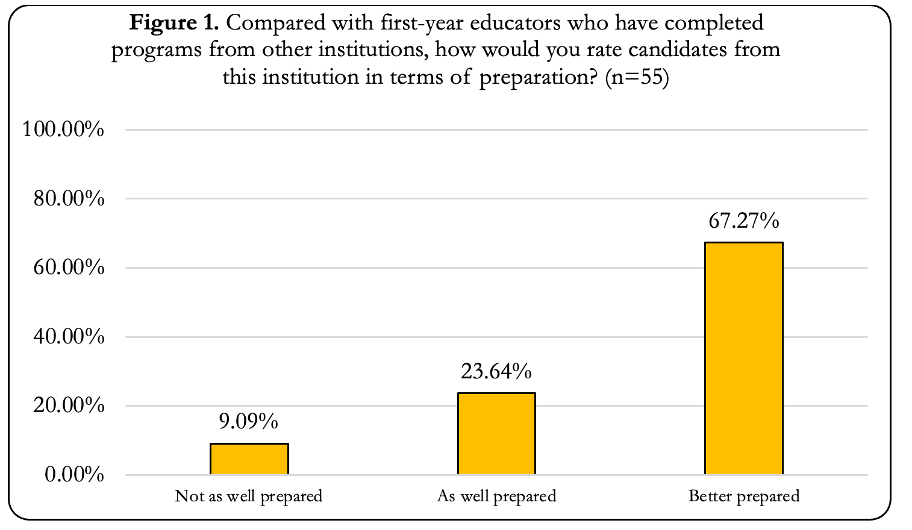
The Initial Level Employer Survey was administered in the Spring of 2025. Specifically, employers of individuals who had completed their initial level teacher preparation program during the Fall 2023-Summer 2024 academic year received an invitation to complete the survey. The Unit response rate for this administration was 40.50%. The following Figure 1 and Tables 1-9 summarize the employer satisfaction data collected through administration of the Spring 2025 Initial Level Employer Survey.
|
Table 1 FOUNDATIONS |
||||||||
|
|
% Strongly Disagree |
% Disagree |
% Agree |
% Strongly Agree
|
% Agree or Strongly Agree |
Mean |
Median |
Valid n |
|
The educator uses a variety of teaching strategies to enhance student learning and development |
0.0% |
4.2% |
62.5% |
33.3% |
95.8% |
3.29 |
3.00 |
48 |
|
The educator accounts for and uses the variety of factors (school, family, cultural, community) that influence the quality of education for all students. |
0.0% |
4.2% |
70.8% |
25.0% |
95.8% |
3.21 |
3.00 |
48 |
|
The educator knows the content of their field. |
0.0% |
6.3% |
58.3% |
35.4% |
93.8% |
3.29 |
3.00 |
48 |
|
The educator understands and abides by the state and federal laws that directly impact the school. |
0.0% |
2.1% |
52.1% |
45.8% |
97.9% |
3.44 |
3.00 |
48 |
|
Table 2 PLANNING |
||||||||
|
|
% Strongly Disagree |
% Disagree |
% Agree |
% Strongly Agree
|
% Agree or Strongly Agree |
Mean |
Median |
Valid n |
|
The educator’s lesson plans align with district, state, and/or national standards |
0.00% |
4.20% |
66.70% |
29.20% |
95.80% |
3.25 |
3 |
48 |
|
The educator implements lesson plans that build on their students’ existing knowledge and skills. |
0.00% |
4.20% |
70.80% |
25.00% |
95.80% |
3.21 |
3 |
48 |
|
The educator manages their time efficiently with lesson plans that include a satisfactory amount of information that is provided in a timely manner. |
0.00% |
2.10% |
76.60% |
21.30% |
97.90% |
3.19 |
3 |
47 |
|
The educator provides instruction that meets the learning needs of all of their students. |
0.00% |
8.30% |
70.80% |
20.80% |
91.70% |
3.13 |
3 |
48 |
|
Table 3 INSTRUCTION |
||||||||
|
|
% Strongly Disagree |
% Disagree |
% Agree |
% Strongly Agree
|
% Agree or Strongly Agree |
Mean |
Median |
Valid n |
|
The educator uses effective communication techniques in order to develop a positive learning environment. |
0.00% |
4.20% |
58.30% |
37.50% |
95.80% |
3.33 |
3 |
48 |
|
The educator employs teaching skills that reflect current theory, research, and practice. |
0.00% |
6.30% |
70.80% |
22.90% |
93.80% |
3.17 |
3 |
48 |
|
The employer provides student-centered instruction that is clear, varies, and is flexible. |
0.00% |
2.10% |
68.80% |
29.20% |
97.90% |
3.27 |
3 |
48 |
|
The educator provides instruction with confidence and clarity in their technique. |
0.00% |
4.20% |
68.80% |
27.10% |
95.80% |
3.23 |
3 |
48 |
|
Table 4 ASSESSMENT |
||||||||
|
|
% Strongly Disagree |
% Disagree |
% Agree |
% Strongly Agree
|
% Agree or Strongly Agree |
Mean |
Median |
Valid n |
|
The educator appropriately utilizes the outcomes of assessments to develop instruction that meets the needs of all students. |
0.00% |
10.60% |
74.50% |
14.90% |
89.40% |
3.04 |
3 |
47 |
|
The educator adheres to ethical and unbiased assessment practices. |
0.00% |
2.10% |
61.70% |
36.20% |
97.90% |
3.34 |
3 |
47 |
|
The educator accurately interprets assessment results. |
0.00% |
4.30% |
78.70% |
17.00% |
95.70% |
3.13 |
3 |
47 |
|
The educator designs assessments that accurately measure the abilities of a variety of students. |
0.00% |
4.30% |
83.00% |
12.80% |
95.70% |
3.09 |
3 |
47 |
|
Table 5 TECHNOLOGY |
||||||||
|
|
% Strongly Disagree |
% Disagree |
% Agree |
% Strongly Agree
|
% Agree or Strongly Agree |
Mean |
Median |
Valid n |
|
The educator uses a variety of technologies to differentiate instruction. |
0.00% |
6.40% |
68.10% |
25.50% |
93.60% |
3.19 |
3 |
47 |
|
The educator uses technology to enhance their overall practice. |
0.00% |
0.00% |
59.60% |
40.40% |
100.00% |
3.4 |
3 |
47 |
|
The educator adapts to new technologies and effectively learns how to use websites and tools provided by the district. |
0.00% |
2.10% |
66.00% |
31.90% |
97.90% |
3.3 |
3 |
47 |
|
The educator applies the foundations of technology to their lessons and assessments in which technology is used. |
0.00% |
0.00% |
72.30% |
27.70% |
100.00% |
3.28 |
3 |
47 |
|
Table 7 MOTIVATION & ENGAGEMENT |
||||||||
|
|
% Strongly Disagree |
% Disagree |
% Agree |
% Strongly Agree
|
% Agree or Strongly Agree |
Mean |
Median |
Valid n |
|
The educator manages student behavior in their classroom. |
2.10% |
14.90% |
55.30% |
27.70% |
83.00% |
3.13 |
3 |
47 |
|
The educator communicates with family and community members in order to make them partners in the educational process. |
0.00% |
12.80% |
59.60% |
27.70% |
87.20% |
3.15 |
3 |
47 |
|
The educator creates a learning environment that promotes learning and safety. |
0.00% |
6.40% |
59.60% |
34.00% |
93.60% |
3.28 |
3 |
47 |
|
The educator organizes their tasks and time in an efficient way for student behavior. |
0.00% |
6.40% |
72.30% |
21.30% |
93.60% |
3.15 |
3 |
47 |
|
Table 8 PROFESSIONALISM & ETHICAL BEHAVIOR |
||||||||
|
|
% Strongly Disagree |
% Disagree |
% Agree |
% Strongly Agree
|
% Agree or Strongly Agree |
Mean |
Median |
Valid n |
|
The educator understands the legal and ethical practices in education. |
0.00% |
4.30% |
72.30% |
23.40% |
95.70% |
3.19 |
3 |
47 |
|
The educator establishes relationships with all stakeholders 9school personnel, parents, community, etc) to support student learning. |
0.00% |
12.80% |
63.80% |
23.40% |
87.20% |
3.11 |
3 |
47 |
|
The educator appropriately approaches difficult conversations in a professional way that advocates for student learning. |
0.00% |
6.40% |
76.60% |
17.00% |
93.60% |
3.11 |
3 |
47 |
|
The educator engages in ongoing professional learning and continually evaluates and improves their professional practice. |
0.00% |
4.30% |
66.00% |
29.80% |
95.70% |
3.26 |
3 |
47 |
|
Table 9 REFLECTIVE PRACTICE |
||||||||
|
|
% Strongly Disagree |
% Disagree |
% Agree |
% Strongly Agree
|
% Agree or Strongly Agree |
Mean |
Median |
Valid n |
|
The educator self-reflects in order to improve their teaching practice. |
0.00% |
4.30% |
66.00% |
29.80% |
95.70% |
3.26 |
3 |
47 |
|
The educator uses multiple resources such as professional literature, mentoring, and interaction with colleagues to aid their growth. |
0.00% |
8.50% |
66.00% |
25.50% |
91.50% |
3.17 |
3 |
47 |
|
The educator accepts constructive criticism from colleagues and students and uses it to improve their teaching practice. |
0.00% |
2.10% |
66.00% |
31.90% |
97.90% |
3.3 |
3 |
47 |
|
The educator shows that they have student learning outcomes in mind when evaluating and adapting their lessons day-to-day and year-to-year. |
0.00% |
8.50% |
68.10% |
23.40% |
91.50% |
3.15 |
3 |
47 |
SATISFACTION OF EMPLOYERS (ADVANCED LEVEL PROGRAMS)|RA4.1
Satisfaction of employers of completers from advanced level programs is demonstrated through administration of the annual Advanced Level Employer Survey. This survey was developed, validated, and is administered by the EPP in the College of Applied Studies at Wichita State University.
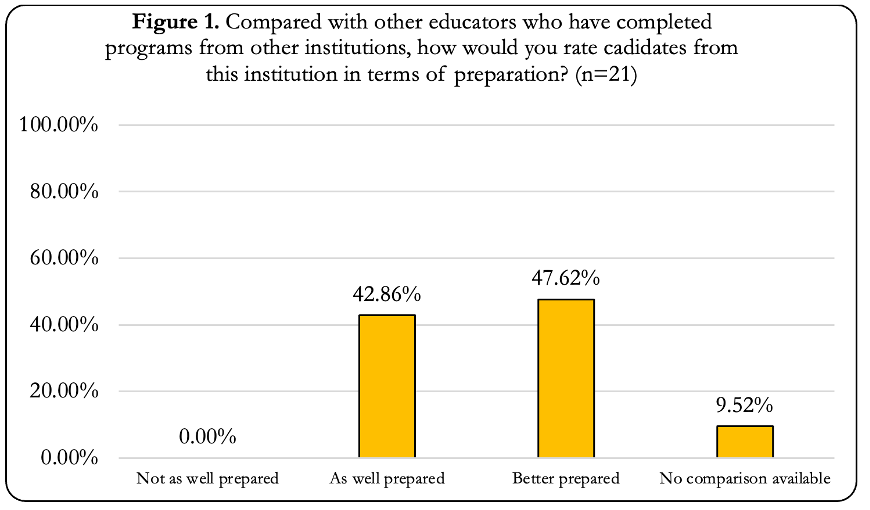
The Advanced Level Employer Survey was administered in the Spring of 2025. Specifically, employers of individuals who had completed an advanced licensure program during the Fall 2023-Summer 2024 academic year received an invitation to complete the survey. The response rate for 2025 was 32.31%.
Figure 1 and Table 10 summarize the Unit level employer satisfaction data collected from the administration of the Spring 2025 Advanced Level Employer Survey.
|
Table 10. Satisfaction with WSU Advanced Program Completer |
||||||||||
|
% Completely Dissatisfied |
% Dissatisfied |
% Satisfied |
% Completely Satisfied |
% Satisfied or Completely Satisfied |
Mean |
Median |
Valid n |
Have not had opportunity to view this |
Does not relate to my employee’s job. |
|
|
I am satisfied with my employee’s ability to understand and apply concepts of human development across the cognitive, linguistic, social, emotional, and physical areas.
|
0.00% |
0.00% |
44.44% |
55.56% |
100.00% |
3.6 |
4.0 |
18 |
0 |
0 |
|
I am satisfied with my employee’s ability to understand and apply concepts of individual differences and diverse cultures and communities in a professional setting.
|
0.00% |
0.00% |
35.29% |
64.71% |
100.00% |
3.6 |
4.0 |
18 |
1 |
0 |
|
I am satisfied with my employee’s ability to understand and apply concepts of assessment in order to guide their professional decision making.
|
0.00% |
0.00% |
22.22% |
77.78% |
100.00% |
3.8 |
4.0 |
18 |
0 |
0 |
|
I am satisfied with my employee’s ability to understand and apply ethical practices in maintaining confidentiality of student or client information. |
0.00% |
5.88% |
11.76% |
82.35% |
94.12% |
3.8 |
4.0 |
18 |
1 |
0 |
STAKEHOLDER INVOLVEMENT|R5.3|RA5.3
The EPP values input from various internal and external partners to inform continuous improvement. Below are meetings conducted in 2024-2025 that included both internal and external stakeholder involvement in program design, evaluation, and continuous improvement.
|
Date |
Committee/Meeting |
Purpose |
Members/Participants |
|
Monthly |
Initial Licensure Teacher Preparation Program Committee (ILTPC) |
To provide overall program curricular leadership for Initial Licensure Programs within the Professional Education Unit. This committee is charged with the following: 1) reviewing data related to initial licensure programs, 2) providing feedback and making decisions about unit operations relevant to initial licensure programs, and 3) review of curriculum and assessment plan changes. This committee reviews recommendations provided by the college assessment committee and accreditation steering committee. |
Internal stakeholders; Members are made up of Initial Licensure Program Chairs, administrative representative from the College of Fine Arts, CAS Advising Center Director, and Associate Dean for Research and Assessment |
|
Monthly |
Advanced Programs Committee (APC) |
To provide overall program curricular leadership for Advanced Programs within the Professional Education Unit. This committee is charged with the following: 1) reviewing data related to advanced programs, 2) providing feedback and making decisions about unit operations relevant to advanced programs, and 3) review of curriculum and assessment plan changes. This committee reviews recommendations provided by the college assessment committee and accreditation steering committee. |
Internal stakeholders; Members are made up of Advanced Program Chairs, Department Heads, and Associate Dean for Research and Assessment |
|
Monthly |
Accreditation Steering Committee |
This committee's work is focused solely on matters of accreditation and state level program approval processes. This committee meets less frequently (1 time per semester) when accreditation and program reviews are not in progress. It is in this committee where matters relevant to the entire professional education unit are discussed, such as information related to the annual reporting process, data management system, scheduling and facilitating program advisory council meetings, and review of unit level data and reports (i.e., professional education unit report). During its review of unit level data and reports, recommendations from the CAS Assessment Committee’s (AC) review are provided and discussed further for feedback and action planning. In some cases, recommendations are made for further review and decision making to occur at ILTPC, APC, or by individual program committees. Programs that are scheduled for review by the CAS AC are notified during this meeting. |
Internal Stakeholders; program chairs from initial and advanced programs within the Professional Education Unit, administrative representative from College of Fine Arts. |
|
Varied, but typically monthly |
Program Committee Meetings |
There is generally one program committee for each program. It is through the Program Committees that most program changes are initiated, implemented, assessed, and then reaffirmed or redesigned. Program Committees are responsible for: 1) providing overall program curricular leadership; 2) reviewing aggregate program candidate and related unit operations assessment data and any special data on assessment properties, 3) establishing and convening the program advisory council; 4) working with relevant faculties/departments to discuss and implement suggested program chances; 5) gathering information/writing reports/responding to special requests for accrediting bodies; 6) maintaining minutes of committee meetings. |
Internal Stakeholders; Program faculty |
|
March 2025, and as needed by individual programs |
Program Advisory Council Meetings |
Program Advisory Councils are convened by their respective program committees and are responsible for: 1) Providing input and advice on programs, including need, curricula, assessments; 2) providing input and advice on tentative program review results/recommendations from program committee based upon program data summaries; 3) providing input/feedback on matters of general concern to school personnel; and, 4) serving as program advocates. |
Internal and External Stakeholders; Each PAC must have at least 5 members that represent the program’s various constituents, especially area practitioners. At least one member is a current candidate in the program and at least one member is a graduate from the program. The faculty program chair convenes the PAC. |