

About D. Cramer Reed
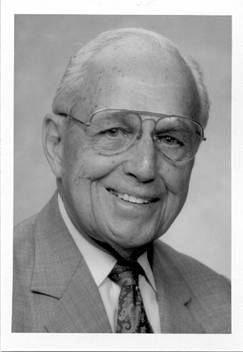
Dr. D. Cramer Reed
Founding Dean, College of Health Professions
Died April 11, 2007 – Larksfield Place, Wichita, Kansas
Dr. D. Cramer Reed, a pioneering physician, educator, and community leader, passed away on April 11, 2007, at Larksfield Place in Wichita. His lifelong dedication to health care, education, and public service shaped some of the most significant medical and academic institutions in the region.
Education and Early Career
Dr. Reed earned his bachelor's degree in biological science from Wichita University in 1937, where he served as class president and played on the football team. He later earned his M.D. from Washington University in St. Louis, where he met his wife, Geney, and subsequently completed his M.S. at the University of Pennsylvania.
He began his medical career in 1946 as a urologist and educator and became the first physician in Wichita to perform kidney dialysis—an important milestone in regional medical history.
Leadership at Wichita State University & KU School of Medicine—Wichita
Dr. Reed served on the Wichita University Board of Regents from 1959 to 1964 and later on the WU Board of Trustees from 1964 to 1969.
After retiring from medical practice in 1970, he was selected as the founding dean of the College of Health Professions at Wichita State University. He also led the effort to bring the University of Kansas School of Medicine to Wichita and was named the founding dean of KU School of Medicine–Wichita in 1971.
Even after retiring from both institutions, he continued to serve as a clinical professor of health education at WSU and a clinical professor of surgery at KU School of Medicine–Wichita. As medical director and vice president for medical affairs at Wesley Medical Center, he co‑founded Health Strategies. He retired from Wesley in 1986 and continued his work as a health care consultant.
Community Service and Recognition
Dr. Reed’s community involvement was broad and impactful. He served on the boards of:
- The Institute of Logopedics
- Kansas Society of Crippled Children
- Senior Services
His many honors include the Uncommon Citizen Award (1989) from the Wichita Area Chamber of Commerce and being recognized as one of the Outstanding Citizens of Wichita (2003) alongside his wife, Geney, by the Mayor and City Council.
Relationship with WSU & Lasting Honors
A Wichita State University Distinguished Alumni Award recipient, Dr. Reed also served as president of the WSU Alumni Association Board of Directors from 1951 to 1952. He was a longtime member and chair of the College of Health Professions Dean’s Advisory Committee.
To honor his extraordinary contributions, the College of Health Professions—along with colleagues and friends—established the D. Cramer Reed Faculty Development Fund in 1990.
Dr. and Mrs. Reed also created:
- A scholarship/fellowship for students in the College of Health Professions
- An endowed fund for departmental support
- Start‑up funding for the College’s Leadership Academy
The D. Cramer Reed Lecture Hall in Ahlberg Hall stands as a permanent tribute to his leadership and legacy.
"I urge each of you to pursue your chosen field with sincere humility and greater empathy with your
patients than many other health care providers have demonstrated in the past.
You are the models -- you have the power to be change agents quite capable of influencing your peers
to quietly bring more humanness to all that we do. If we do not initiate a 'kinder,
gentler' approach to our patient contacts, we will not be living up to our full
potential as premier health professionals."
- Dr. D. Cramer Reed, Commencement Address, College of Health Professions
Commencement, May 2000
Reflection on Dr. Cramer Reed
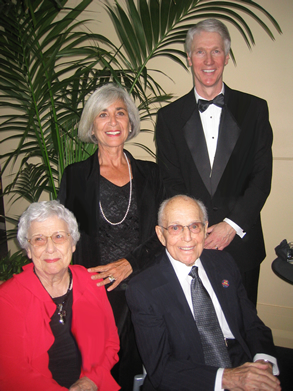
University of Kansas Medical Center, Honorary Alumni Award, Sept. 16, 2006
Kit Fuller (daughter, top left); Dr. Peter Cohen (top right); Geney Reed (wife, bottom
left); and Dr. Cramer Reed (bottom right)
Although it is difficult to express what Cramer Reed meant to me in a few words, I will try. Quite simply, Cramer was the most remarkable man I’ve ever known. I have thought of him nearly every day since the moment I met him nine years ago, during my interview for my position at Wichita State University. He was already in his eighties then and had accomplished the extraordinary things for which he will always be remembered.
Even though I did not share in the full history of his impact on this community, I felt an immediate and deeply personal connection with him from the moment we met. He was, in fact, the primary reason I chose to come to Wichita. Over time, I came to realize that Cramer had this effect on almost everyone he encountered. Greatness is seen not only through the eyes and minds of others, but through their hearts—and I saw his greatness reflected in the hearts of the people he touched, including my own.
Several years ago, he and I began discussing leadership, and I told him how much I admired Jim Collins’ concept of “Level 5 leaders” from Good to Great. Collins describes these leaders as possessing a rare blend of deep personal humility and intense professional resolve. Cramer asked me if I had ever met such a leader. I thought for a moment and said, “Yes, Cramer, I’ve met one such person—and I’m talking to him right now.” He simply laughed, shook his head, and patted my arm.
Without fully realizing it, Cramer became the most important mentor and role model in my life. I’m certain, though, that he always knew he was my friend.
By Dr. Peter Cohen, WSU Dean of the College of Health Profession from 1998-2013
Cramer Reed Memorial Service
Hughes Metropolitan Complex
April 14, 2007
Remarks by James J. Rhatigan, WSU Dean of Students from 1965-2002
Geney Reed invited several people to write comments about Cramer. Some wrote long reflections, others brief notes, but each one reflected a unique relationship with him. Reading these memories was a deeply moving experience, and together they form a powerful portrait of the life and character of Cramer Reed.
Early Leadership & Emerging Values
From high school onward, the person we came to know as Cramer Reed took unmistakable shape. His core values were already present—intelligence, purpose, and boundless energy. At North High, he was elected class president every year. At the University of Wichita, he repeated the pattern, graduating as a senior honor man and again serving as class president each year. He did the same in medical school.
If you didn’t know him, you might assume he was preparing for a political career. In truth, he was an exceptional politician of a different sort—one who never ran for office. His warmth, his academic ability, and his genuine faith in others drew people to him effortlessly.
Humility, Grace, and Personal Character
Many who wrote about Cramer described his charm, grace, and wit—qualities grounded in an authentic humility. It wasn’t something he emphasized about himself, but it was part of why people admired him without envy. To spend time with Cramer required leaving pettiness behind. His attention was always on what mattered: meaningful issues, important work, and new possibilities that others had not yet seen.
Lena Mae Brooks, who met Cramer 76 years ago at North High, said he had stood by her throughout her life. She may have spoken for many when she described him as “the most beloved man in Wichita.”
A Legacy of Caring and Encouragement
Cramer’s empathy and compassion were defining traits. His friend, nurse Alma Fulton, shared a story from 60 years ago when she was mistreated during her training and doubted whether she should continue. Cramer found her, offered reassurance, and encouraged her to stay the course. “Alma, you will be a fine nurse,” he told her. She later witnessed the deep respect he earned among nurses—not because he demanded it, but because he deserved it.
As Dr. Norman Pullman put it, “It was a privilege to have him call you friend.”
Manners, Mentorship & Raising Others Up
Cramer’s impeccable manners became something of a trademark—natural, effortless, never manipulative. Women who knew him often held him up as a model of courtesy and grace.
His ability to bring out the best in others was legendary. Jerry Kerschen, Jim Moore, and Lorene Valentine saw in him a gentle mentor who encouraged higher behavior and better choices. Whether he had to work at this or it came naturally, we may never know.
People sought his advice on politics, fundraising, personal dilemmas, and often medical questions. What might have been interruptions to others seemed to Cramer simply part of his day—part of who he was.
Building People and Institutions
Bob O’Brien learned from Cramer the importance of surrounding oneself with people of strong values. Marni Vliet wondered whether anyone in Wichita had nurtured more careers. Many felt that Cramer elevated their own ethical standards.
Although countless people benefited from his guidance, Cramer also shaped institutions in lasting ways:
-
Founding Dean, WSU College of Health Professions
He led the college in its earliest days, when it operated out of Fairmount Towers. Today it thrives in Ahlberg Hall with more than a thousand students. -
Founding Dean & First Vice Chancellor, KU School of Medicine–Wichita
Cramer brought the medical school to life, navigating controversy and building a foundation of excellence. -
Health Strategies
His influence is visible to all who visit the facility on Hillside. -
Larksfield Place
Perhaps his greatest institutional achievement, envisioned as a retirement community focused on vitality and excellence. The Cramer Reed Center stands as a national model, and more than a dozen residents have lived independently beyond age 100. -
Shepherd’s Center at East Heights Methodist
Cramer founded the program. -
Lifeline Program
Established in Wichita through Cramer’s initiative.
These contributions touch only a fraction of his work. His days began at 5:30 a.m. and ended in the evening, yet he somehow found time to move mountains.
The Power of Influence
Cramer often accomplished what no one else could. His network of relationships, built over decades, gave him a unique ability to shape outcomes. Fran Jabara once noted that Cramer seemed to retire repeatedly—only to re-emerge each time with new ideas and new ways to serve.
One example:
When Phil Frick began work on Exploration Place, the first person he called was Cramer.
Phil wondered whether Velma Wallace might support the project. Cramer approached her,
and she agreed—ultimately providing the gift that anchored the entire effort. She
later joked, “Cramer was the only one who could have talked me out of that much money.”
Cramer went on to serve eight years as a trustee for Exploration Place.
Shaping Wichita State University
Few know that Cramer played a central role in one of the most defining decisions in Wichita State history. When President Harry Corbin resigned in 1963, the Board of Regents—led by Cramer—had to choose a successor at a time when tensions around entering the state system were high.
Cramer insisted the university needed a scholar of the highest caliber. Through persistence and remarkable diplomacy, he persuaded Dr. Emory Lindquist to accept the presidency. Lindquist’s leadership stabilized the institution’s future.
Without Cramer, Wichita State University’s history might look very different.
A Final Moment
Ultimately, we gather to say goodbye. But every ending also marks a beginning.
Dr. Ernie Crow, leaving Cramer’s room at the Larksfield Care Center for the last time, experienced a moment that captured the essence of his friend of more than 60 years. As Ernie prepared to go, Cramer looked at him and simply asked:
“Are you OK?”
Even at the end, his concern was for others.