

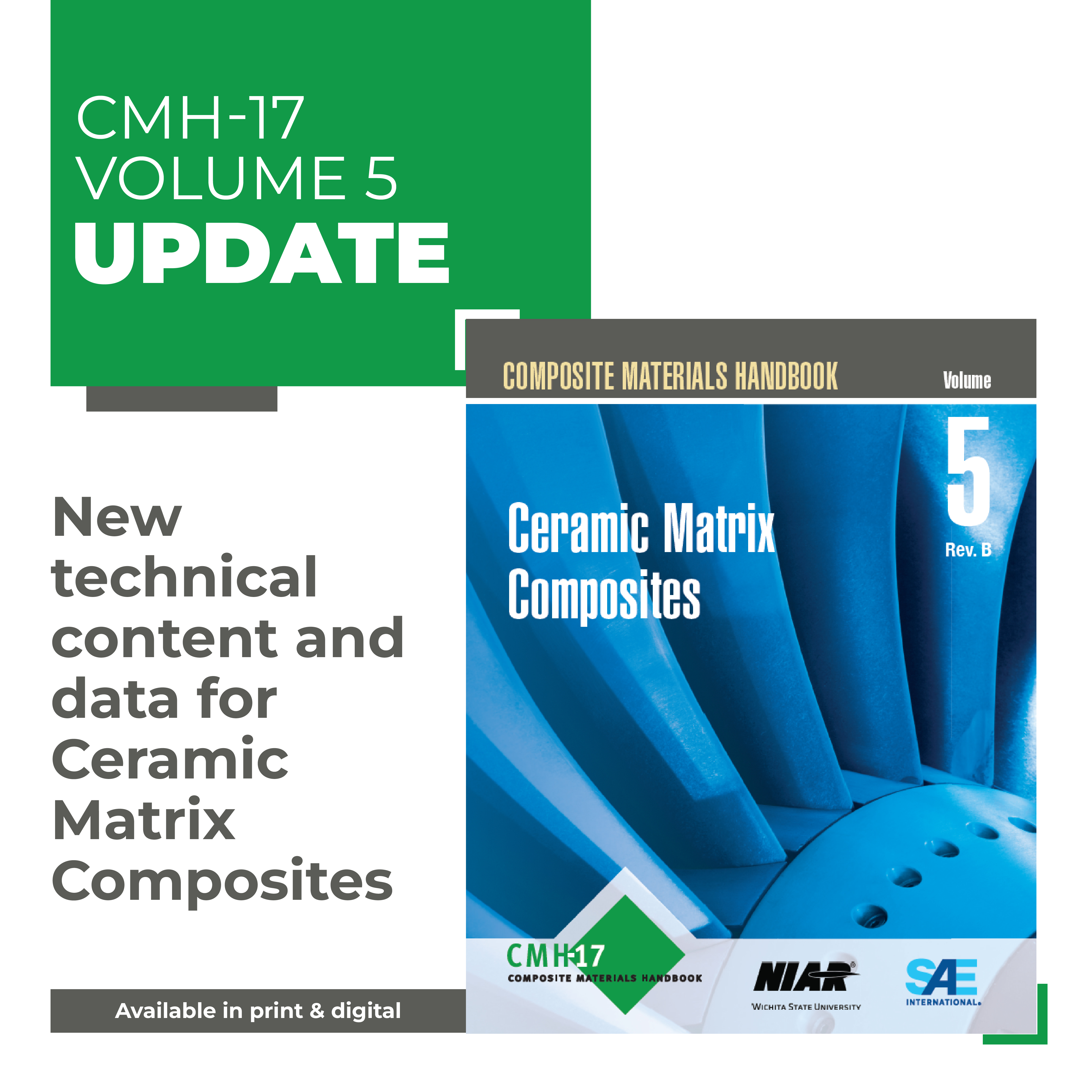
 Wichita State University’s National Institute for Aviation Research (NIAR) announces the release of a significant update to the Composite Materials Handbook (CMH-17) Volume 5.
CMH-17 Volume 5 Revision B delivers new technical content and data focused on the growing use of Ceramic Matrix Composites (CMC) in advanced aerospace and propulsion applications. The new revision is available for purchase in print and digital format through SAE International.
This revision, led by CMH-17 members from industry, government, and academia, expands on critical topics for CMCs including a new chapter on engine applications. The latest update reflects increased industry adoption of CMC materials and provides engineers, designers, program managers, and students with exclusive guidelines and insight.
The release of Volume 5 Revision B coincides with the celebration of 30 years of coordinated industry efforts CMC materials and processes. Since its inception in 1996, the CMC coordination group has worked to advance understanding, improve consistency, and establish best practices across the field. This revision highlights the progress achieved over three decades and reinforces a commitment to continued innovation and collaboration.
New and enhanced content includes:
- Expanded coverage of environmental barrier coatings, addressing performance and durability considerations for CMC systems
- New guidelines and best practices for CMC testing, supporting consistent and reliable material evaluation
- A new chapter dedicated to engine applications of CMCs
- The first CMC data set to be included in CMH-17: oxide-oxide
Inclusion of the new oxide-oxide data set represents a major milestone for the aerospace community. This is an interim data set and does not include B-basis allowables.
NIAR serves as secretariat for CMH-17, which holds regular meetings to create, publish, and maintain proven material data and engineering information. This material, subjected to thorough technical review, supports the development and use of advanced materials and structures in aerospace applications.
Data published in CMH-17 is evaluated under material equivalency requirements established by the Federal Aviation Administration rather than under full material allowables programs. This distinction enables users to significantly reduce the cost and time associated with material qualification and aircraft certification, simplifying the effort for broader adoption of CMC materials across the industry.
CMH-17 supports CMC industry professionals with:
- Access to updated guidelines for CMC material systems that are not available in any other single reference
- Shared best practices for the design, analysis, and testing of CMCs that are typically proprietary to individual companies, giving users deeper understanding and better preparation for certification programs and emerging career paths
- A comprehensive reference for designers, engineers, program managers, and students working with CMCs
- Content developed and authored by industry practitioners who design, manufacture, test, and certify CMC systems in real-world aerospace applications
The updated Composite Materials Handbook continues to serve as the authoritative reference for composite materials, delivering expanded, practical guidance for one of the fastest-growing and most strategically important material systems in aerospace.
Volume 5 Revision B is available for purchase at SAE Books.
About CMH-17
The Composite Materials Handbook (CMH-17) is the authoritative worldwide focal point for technical information on composite and non-metallic additive manufactured materials and structures in aerospace applications. CMH-17 is a reliable source of engineering information and standards on composite materials and structures, including polymer matrix, metal matrix, ceramic matrix, and structural sandwich composites. A seventh volume, which is in development, will provide similar content for non-metallic additive manufactured materials. CMH-17 provides information and guidelines necessary to design, substantiate, manufacture, certify, and support end items using advanced materials in aviation applications. It also includes material properties that meet specific data requirements.
About SAE International®
SAE International is a global organization committed to advancing mobility knowledge and solutions for the benefit of humanity. By engaging nearly 200,000 engineers, technical experts and volunteers, we connect and educate mobility professionals to enable safe, clean, and accessible mobility solutions. We act on two priorities: encouraging a lifetime of learning for mobility engineering professionals and setting the standards for industry engineering. We strive for a better world through the work of our philanthropic SAE Foundation, including award-winning programs like A World In Motion® and the Collegiate Design Series™. Learn more at www.sae.org.
SAE Contact: Jeff Laskowski, SAE International 248.925.4770 pr@sae.org
CMH-17 Contact: info@cmh17.org
Special Notice:
CMH-17 is seeking a dedicated working group chair to continue the advancement of industry best practices in CMC materials and processes. Working group chairs lead regular technical discussions, guide the development of new content, and coordinate documentation that shapes the future of this volume. Individuals with expertise in CMC materials, processing, or applications are encouraged to get involved and help drive this important industry effort. For more information or to express interest, please contact the CMH-17 Secretariat at info@cmh17.org