

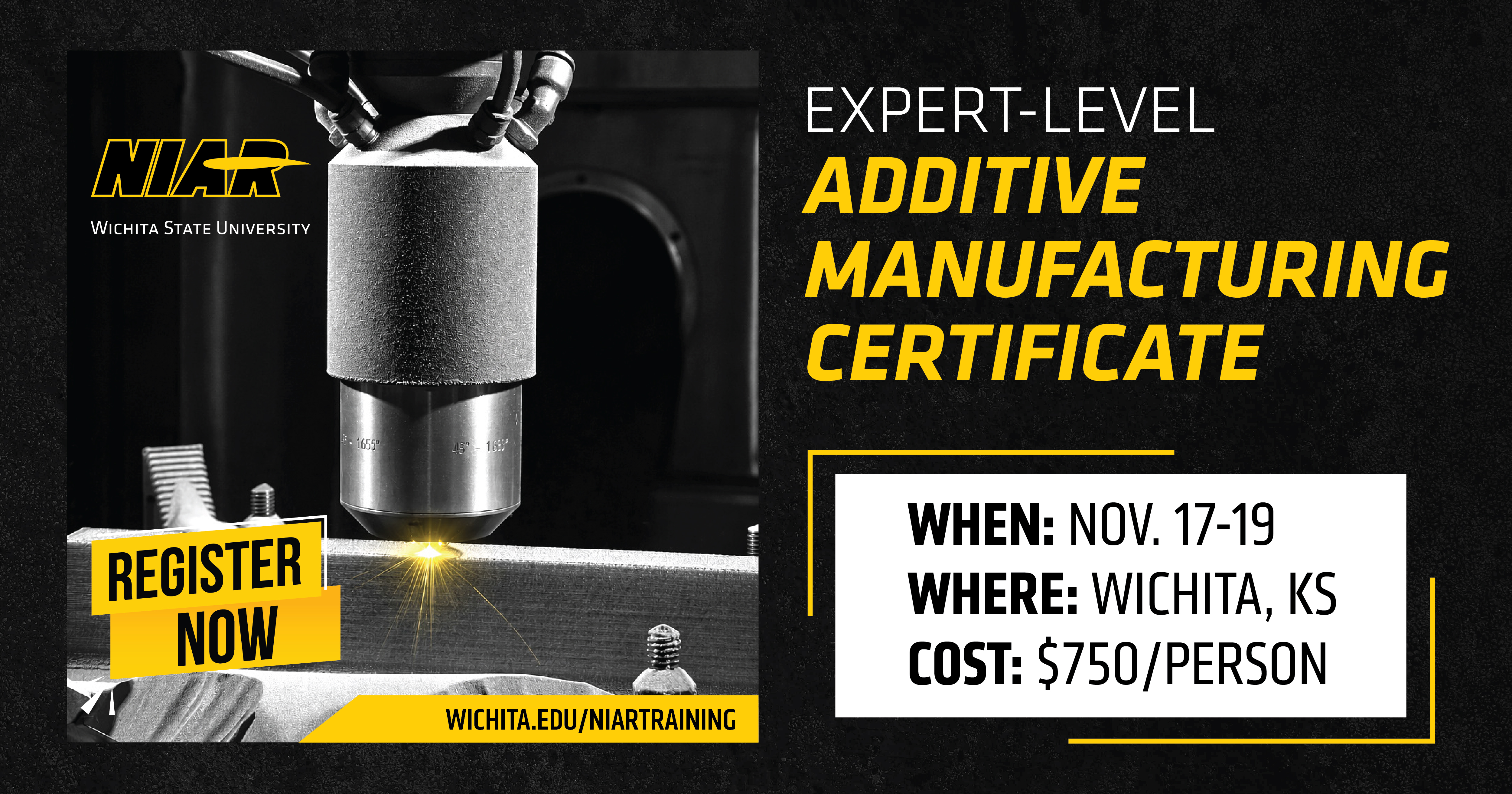
When: November 17-19
Where: Wichita, KS
Cost: $750 / Seat
- Only 13 spots available. Registration is open until all spots are filled or will close on November 13th, 2026.
- Open to graduate students, engineers, manufacturing professionals, technicians, researchers seeking to develop industry-oriented skills in Additive Manufacturing.
- Attendees will have access to the class materials and will receive a Certificate of Completion at the end of the training.
- No prerequisites are required, but a basic understanding of 3D printing is recommended.
Course Learning Objectives:
- Provides advanced-level CAD training for AM.
- Learn the importance of performing topology optimization on legacy parts.
- Acquaint yourself with parameter optimization, quality (ASTM-driven procedures), and the business and economics aspects of AM.
- Primarily focuses on metal AM using powder bed fusion (PBF) technology to produce parts.
- Demonstrates how Model-Based Systems Engineering (MBSE) principles can be applied to 3D printing as an Industry 4.0 tool.
Course Topics:
- Module 1 – AM Business & Economics
Impact of AM on the global supply chain, influence of cost-effective AM systems, future of AM, the economics of AM, AM business case development, AM example parts, case studies- Traditional Manufacturing vs. Additive Manufacturing, ROI calculator - Module 2 – Topology Optimization (TO)
What is Topology Optimization?, advantages of TO, Topology Optimization process, applications of TO, TO software, traditional TO Vs modern TO, TO on 3DEXPERIENCE, TO design exercise. - Module 3 – Advanced CAD for AM
CATIA 3DEXPERIENCE Wireframe and Surfaces for geometry creation, surface operations, wireframe/surface analysis, and integration within Part Design, applications of CAD in AM. - Module 4 – Metal AM
Powder Bed Fusion (PBF) essentials, metallic materials, powder manufacturing, attributes, characterization/ characteristics, PBF print parameters, diagnosing metal AM defects, slicer software, machine setup, build, post-processing. - Module 5 – AM Certification & Qualification
Certification, destructive and non‑destructive testing, qualification framework/steps, and governing standards. - Module 6 – Model-Based Systems Engineering (MBSE)
Introduction to MBSE, Systems Modeling Language (SysML) basics, creating graphical models in CATIA Magic Cyber Systems Engineer, Additive Manufacturing use case.
Course Outcomes:
By the end of the course, participants will be able to:
- Understand the business and economic aspects of additive manufacturing and propose a business model.
- Generate a topology-optimized structure by modifying the design of a legacy part.
- Apply advanced wireframe and surface design tools and operations to develop a complex CAD part.
- Determine the appropriate print parameters to carry out a successful PBF print.
- Produce a 3D-printed part using a PBF machine.
- Apply Certification & Qualification concepts for AM.
- Analyze the quality of AM components by gaining a comprehensive understanding of testing methods standardized by ASTM.
- Apply MBSE concepts to 3D printing as an Industry 4.0 tool.
November 17
National Center for Aviation Training, Manufacturing Training Center,
4004 N. Webb Rd Wichita, KS 67226
Room M164 (CAD/CAM Lab)
9:00 a.m. – 9:15 a.m. : Introduction to Additive Manufacturing (AM)- Review
9:15 a.m. – 10:30 a.m. : AM Business & Economics
10:30 a.m. – 12:00 p.m. : Topology Optimization
NOON – 1:15 p.m. : Lunch Break
1:15 – 4:30 p.m. : Advanced CAD for AM
November 18
National Center for Aviation Training, Manufacturing Training Center,
4004 N. Webb Rd Wichita, KS 67226
Room M164 (CAD/CAM Lab)
9:00 a.m. – 10:30 a.m. : Metal AM
10:30 a.m – 12:00 p.m. : AM Certification & Qualification
NOON – 1:15 p.m. : Lunch Break
1:15 – 4:30 p.m. : Model-Based Systems Engineering (MBSE), ASTM Testing
November 19
Hub for Advanced Manufacturing and Research
1907, Innovation Blvd, Wichita, KS 67208
Room 202
9:00 a.m. – 11:00 a.m. : Metal AM demo on the EOS M 290 (PBF Machine)