

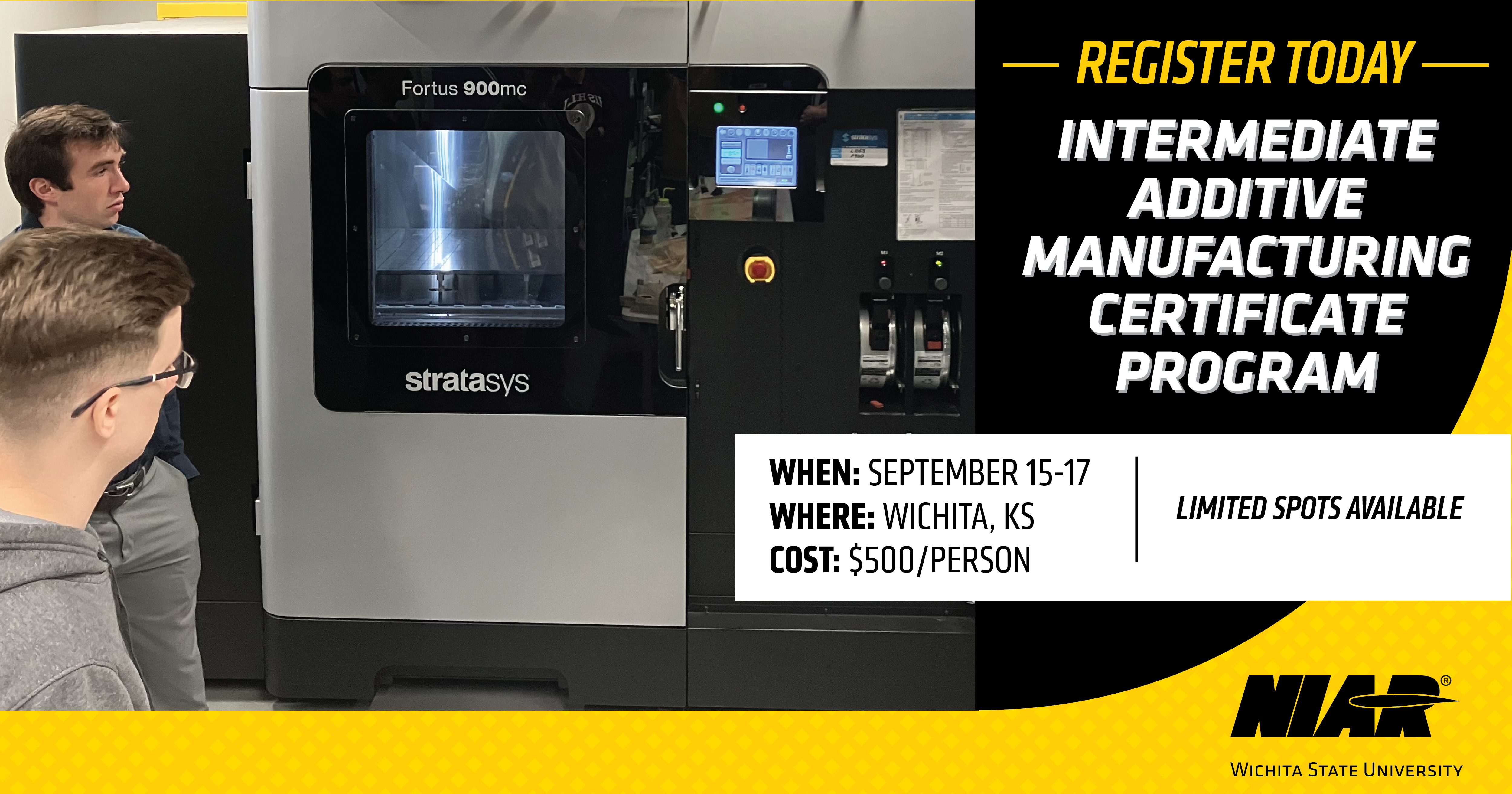
When: September 15 - 17, 2026
Where: Wichita, KS
Cost: $500 / Seat
- Only 13 spots available. Registration is open until all spots are filled or will close on September 11, 2026.
- Open to graduate students, engineers, manufacturing professionals, technicians, researchers seeking to develop industry-oriented skills in Additive Manufacturing.
- Attendees will have access to the class materials and will receive a Certificate of Completion at the end of the training.
Course Learning Objectives:
-
- Gain an understanding of the general design rules/guidelines pertaining to polymer and metal additive manufacturing via DfAM exercises.
- Know the best practices of safety aspects while working with 3D printing.
- Learn how to do Finite Element Analysis (FEA) and apply it for 3D printing by incorporating the entire FEA workflow.
- Carry out 3D printing on an industrial grade machine that includes slicer software, machine setup, build, post-processing, etc.
Course Topics:
- Module 1 – Design for AM (DfAM): Fundamentals & Principles
Introduction to design, DfAM case studies, support structures, stress concentration, residual stress, general AM design rules, polymer AM general design rules, metal AM general design rules, standard DfAM workflow. - Module 2 – Design for AM (DfAM): Advanced Strategies & Applications
Intermediate CAD, DfAM exercises, efficient design techniques, designing 3D-printed joints, tolerances, slicer software, best practices, material selection, engineering aspects of product design. - Module 3 – AM: Environment, Health and Safety
Introduction to environment, health, and safety (EHS), 3D printing hazards, best practices, personal protective equipment, waste disposal, safety signs, safety precautions, machine-specific examples, key EHS organizations. - Module 4 – Finite Element Analysis (FEA)
Introduction to engineering problems, importance of FEA, objectives of FEA, stress-strain behavior, FEA workflow, 3DEXPERIENCE SIMULIA Abaqus, FEA validation checks, practical FEA exercises for metal and polymer AM 3D-printed parts. - Module 5 – Industrial Grade 3D Printing
3D printing demo on the Stratasys F900, slicer software demo, machine setup, build, post-processing, reverse engineering demo.
Course Outcomes:
- Apply the DfAM rules/ guidelines prior to manufacturing a 3D printed part.
- Design AM parts in the most efficient manner with minimum support structures.
- Understand the basic terms and definitions associated with environment, health & safety in AM.
- Identify common risks associated with AM.
- Be enabled to take preventative actions to minimize and mitigate risks.
- Explain the typical FEA workflow.
- Analyze the part prior to 3D printing and predict its behavior under real-world loading conditions via FEA simulations.
- Create a part on an industrial grade 3D printing machine.
September 15
National Center for Aviation Training, Manufacturing Training Center,
4004 N. Webb Rd Wichita, KS 67226
Room M164 (CAD/CAM Lab)
9:00 a.m. – 9:45 a.m. : Introduction to Additive Manufacturing (AM)- Review
9:45 a.m. – 12:00 p.m. : Design for Additive Manufacturing (DfAM): Fundamentals and Principles
NOON – 1:15 p.m. : Lunch Break
1:15 – 3:00 p.m. : Design for Additive Manufacturing (DfAM): Fundamentals and Principles
3:00 – 5:00 p.m. : Design for Additive Manufacturing (DfAM): Advanced Strategies and Applications
September 16
National Center for Aviation Training, Manufacturing Training Center,
4004 N. Webb Rd Wichita, KS 67226
Room M164 (CAD/CAM Lab)
9:00 a.m. – 10:00 a.m. : Design for Additive Manufacturing (DfAM): Advanced Strategies and Applications
10:00 a.m – 11:00 a.m. : AM: Environment, Health & Safety
11:00 a.m. – 12:00 p.m. : Finite Element Analysis (FEA)
NOON – 1:15 p.m. : Lunch Break
1:15 – 5:00 p.m. : Finite Element Analysis (FEA)
September 17
Hub for Advanced Manufacturing and Research
1907, Innovation Blvd, Wichita, KS 67208
9:00 a.m. – 11:00 a.m. : Industrial Grade 3D printing