

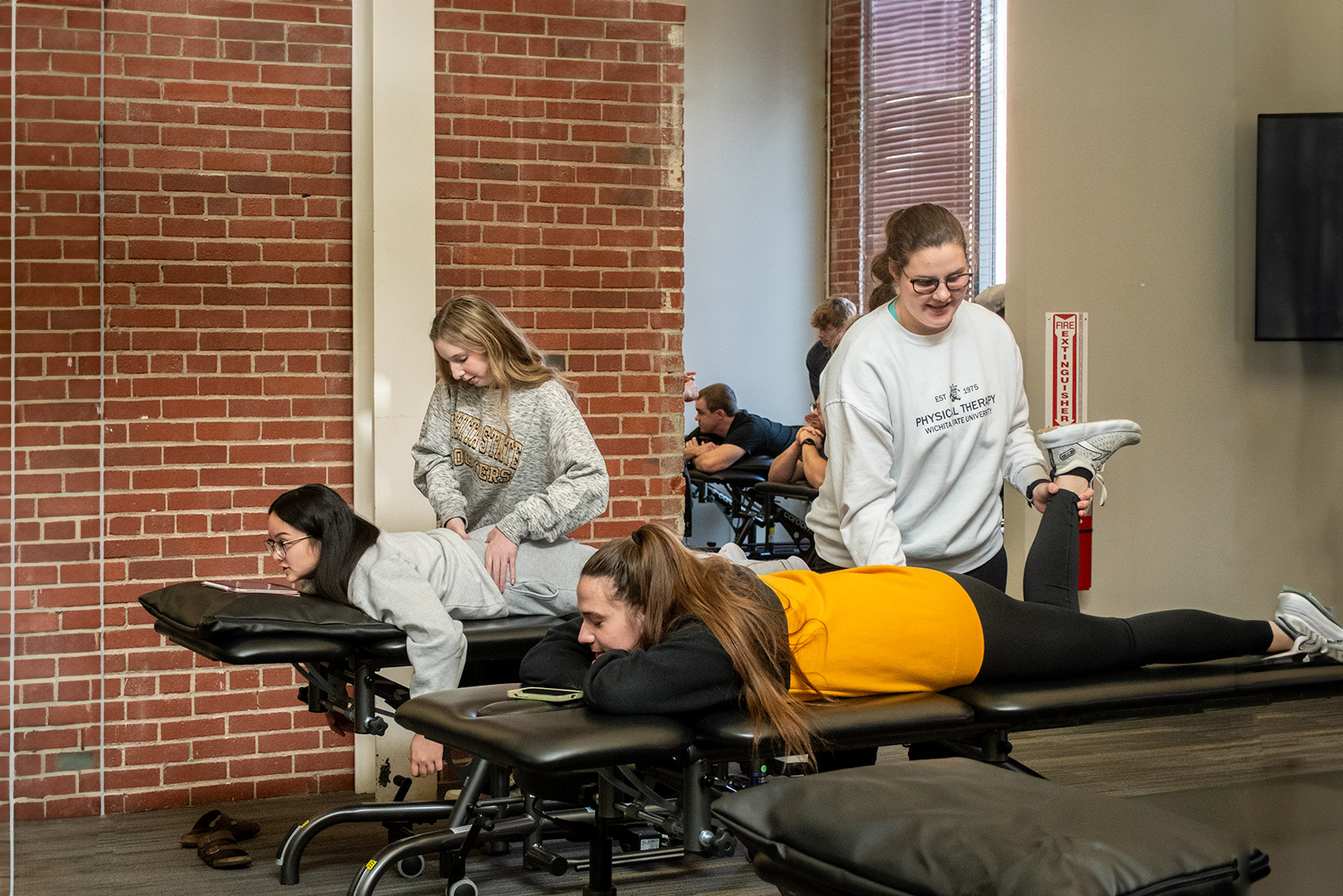
About the Department of Physical Therapy
Physical Therapy Mission
The mission of the College of Health Professions Department of Physical Therapy program is to graduate competent, compassionate, progressive physical therapists capable of serving diverse populations through direct access and collaborative care across a variety of settings.
Physical Therapy Vision
The vision of the College of Health Professions Department of Physical Therapy program
is to be a recognized leader in advancing the physical therapy profession by cultivating
life-long learners through excellence in clinical practice, research, leadership and
service.
Accreditation - Physical Therapy Program
The Commission on Accreditation in Physical Therapy Education (CAPTE) granted the Wichita State University Doctor of Physical Therapy program accreditation through 6/30/2033. The Wichita State physical therapy program has maintained accreditation status since its establishment.
The Doctor of Physical Therapy Program at Wichita State University is accredited by the Commission on Accreditation in Physical Therapy Education (CAPTE), 3030 Potomac Avenue, Suite 100, Alexandria, Virginia, 22305; telephone: 703-706-3245; email: accreditation@apta.org; website: http://www.capteonline.org. If needing to contact the program/institution directly, please call 316-978-3621 or email physical therapy@wichita.edu.
Physical Therapy - Objectives
The following goals are set to ensure students and graduates, faculty, and the Program meet or exceed expectations to remain in compliance with CAPTE Standards and the Program, College, and University Missions:
- Students will be advocates for service to the community and the profession.
- Students will demonstrate the skills necessary to practice physical therapy as autonomous practitioners at entry-level competencies, consistent with the American Physical Therapy Association’s Standards of Practice and Minimum Required Skills of Physical Therapist Graduates at Entry-level.
- Graduates will demonstrate the skills necessary to practice physical therapy as autonomous practitioners at entry-level competencies, consistent with the American Physical Therapy Association’s Standards of Practice and Minimum Required Skills of Physical Therapist Graduates at Entry-level.
- Graduates will be employed as physical therapists and provide quality collaborative care.
- The Program faculty will be contemporary educators and scholars who communicate effectively, advise students, and provide service to the college, university, and/or profession.
- Clinical education faculty will be contemporary educators who are effective in planning, coordinating, advising, and mentoring students in and across a variety of clinical settings.
- The Program will admit exceptional students annually.
- The Program will have adequate resources to meet program needs and strategic goals.
In addition, the Program has set strategic goals to continue to enhance the quality of the WSU Doctor of Physical Therapy Program and work towards our vision:
- Faculty are recognized as contemporary practitioners, educators, leaders, and scholarly contributors to the physical therapy profession.
- Students demonstrate academic excellence and are recognized both regionally and nationally for scholarly endeavors.
- The Program faculty, staff, and students are recognized locally and nationally as leaders in service-connected activities.
- The Program will provide a more diverse learning environment by increasing the number of faculty, staff, and students from various backgrounds.
- The Program faculty, students, and graduates are recognized locally and nationally as leaders in their profession.
- Graduates will be life-long learners demonstrating initiative and appropriate clinical decision-making abilities.
Physical Therapy - CAPTE Program Outcome(s) Data Student Assessment Performance Indicators 2024-2026
For the three recent academic years (2024, 2025, 2026) the performance of graduates of the Wichita State University Doctor of Physical Therapy program, as provided on the 2025 Annual Accreditation report to the American Physical Therapy Association, was as follows:
| - | Class of 2024 | Class of 2025 |
2-Year Average 2024-2025 |
National Average 2024-2025 |
Class of 2025 |
Class of 2026 |
2-Year Average 2025-2026 |
|---|---|---|---|---|---|---|---|
| Graduation Rate | 100% | 100% | 100% | 95.3% | 100% |
98.78% |
99.39% |
| First-Time Pass Rate for Licensure Examination | 92.68% | 97.4% | 95.04% | 85.75% | 97.4% | 90.24% | 93.82% |
| Ultimate Pass Rate for Licensure Examination | 100% | 100% |
100%
|
95.5% | 100% | *TBD | *TBD |
| Employment Rate | 100% | 100% | 100% | 99.55% | 100% | *TBD | *TBD |
*Preliminary, awaiting final results
TBD = To be determined
- Graduation Rate: Number of students (in original cohort) who graduated at the normally expected time
- First-time Licensure Pass Rate: Percentage of graduates who passed the National Physical Therapy Licensure Examination (NPTE) upon first attempt
- Ultimate Licensure Pass Rate: Percentage of graduates who passed the NPTE, after all attempts
- Employment Rate: Percentage of graduates seeking employment who were employed as physical therapists within six months of passing the NPTE
Physical Therapy - Licensure Requirements
Licensure requirements are a function of state governments through a physical therapy board. To identify requirements, individual graduates must contact the state physical therapy board of the jurisdiction(s) where they plan to practice. Graduation from an accredited program is only one requirement; satisfactory completion of the physical therapy program does not guarantee licensure for graduates. A list of boards, contact information, and licensure examination information is readily accessible at the Federation of State Boards of Physical Therapy website at http://www.fsbpt.org
Employer Surveys of DPT Graduates
To ensure the program is meeting its goals and expectations, we will send the following Qualtrics survey to employers of our Graduates each spring semester via email. However, if you are an employer of a WSU DPT Graduate, and did not receive the email by June 1st, please email our Program Operations Manager at kelley.shetlar@wichita.edu and ask for a link to complete the survey.
Athletic Training
Mission Statement
The mission of the MSAT is to provide a comprehensive program of academic coursework and field experience that will educate athletic training students for entry-level positions in the profession of athletic training. The MSAT strives to meet the standards, educational competencies, and clinical proficiencies for athletic training education through professional service, research activities, and curriculum design. The MSAT abides by the policies and procedures as set forth by the CAATE, NATA, BOC, and the Kansas Board of Healing Arts.
Athletic Training Accreditation
WSU's MSAT program has been granted accreditation by the Commission on Accreditation of Athletic Training Education (CAATE) through 2032-2033. The CAATE issued the accreditation upon successful completion of a site visit and review of accreditation criteria.
CAATE Program Information and Outcomes
Goals and Objectives of the MSAT
Standard 1
Students will demonstrate an understanding of evidence-based practice concepts and their application to essential clinical decision-making and critical examination of athletic training practice.
Objectives:
- Demonstrate an understanding of evidence-based practice through oral and visual examination of competency testing on skill sheets.
- Demonstrate an understanding of evidence-based practice through written examination.
- Demonstrate an understanding of evidence-based practice through current literature review on case study projects and presentation.
Standard 2
Students will develop and implement strategies and programs to prevent the incidence and/or severity of injuries and optimize their clients/patients overall health and quality of life. (Prevention and Health Promotion).
Objectives:
- Demonstrate an understanding of prevention and health promotion through oral and visual examination of competency testing on skill sheets.
- Demonstrate an understanding of prevention and health promotion through written examination.
- Demonstrate an understanding of prevention and health promotion through current literature review on case study projects and presentation.
Standard 3
Students will demonstrate the ability to possess strong clinical examination skills in order to accurately diagnosis and effectively treat their patients. (Clinical Diagnosis and Evaluation)
Objectives:
- Demonstrate an understanding of clinical examination and diagnosis through oral examination of competency testing on skill sheets.
- Demonstrate an understanding of clinical examination and diagnosis through written and practical examinations.
- Demonstrate an understanding of clinical examination and diagnosis through current literature review on case study projects and presentation.
Standard 4
Students will demonstrate knowledge and skills in the evaluation and immediate management of acute injuries and illnesses. (Acute Care of Injuries and Illnesses).
Objectives:
- Demonstrate an understanding of acute care of injuries and illnesses through oral and visual examination of competency testing on skill sheets.
- Demonstrate an understanding of acute care of injuries and illnesses through written examination.
- Demonstrate an understanding of acute care of injuries and illnesses through current literature review on case study projects and presentation.
Standard 5
Students will demonstrate the ability to assess the patient’s status using clinician-and patient-oriented outcome measures to determine the stage of healing, goals, and therapeutic intervention to maximize the patient’s participation and health-related quality of life. (Therapeutic Interventions)
Objectives:
- Demonstrate an understanding of therapeutic interventions through oral examination of competency testing on skills sheets.
- Demonstrate an understanding of therapeutic interventions through written and practical examinations, quizzes, and homework assignments.
- Demonstrate an understanding of therapeutic interventions through current literature review on case study projects and presentation.
Standard 6
Students will demonstrate the ability to recognize clients/patients exhibiting abnormal social, emotional, and mental behaviors. (Psychosocial Strategies and Referral).
Objectives:
- Demonstrate an understanding of psychological strategies and referral through oral examination of competency testing on skills sheets.
- Demonstrate an understanding of psychological strategies and referral through written and practical examinations, quizzes, and homework assignments.
- Demonstrate an understanding of psychological strategies and referral through current literature review on case study projects and presentation.
Standard 7
Students will demonstrate the ability to function within the context of a complex healthcare system and understand risk management, healthcare delivery mechanisms, insurance, reimbursement, documentation, patient privacy, and facility management. (Healthcare Administration).
Objectives:
- Demonstrate an understanding of healthcare administration through oral examination of competency testing on skills sheets.
- Demonstrate an understanding of healthcare administration through written and practical examinations, quizzes, and homework assignments.
- Demonstrate an understanding of healthcare administration through current literature review on case study projects and presentation.
Standard 8
Students will demonstrate the understanding maintaining competence in healthcare, embrace the athletic training practice within the limits of state and national regulations using moral and ethical judgment, and work collaboratively with other healthcare providers. (Professional Development and Responsibility).
Objectives:
- Demonstrate an understanding of professional development and responsibility through oral examination of competency testing on skills sheets.
- Demonstrate an understanding of professional development and responsibility through written and practical examinations, quizzes, and homework assignments.
- Demonstrate an understanding of professional development and responsibility through current literature review on case study projects and presentation.
Standard 9
Students will demonstrate the clinical integration proficiencies that represent the synthesis and integrations of knowledge, skills, and clinical decision-making into actual client/patient care. (Clinical Integration Proficiencies).
Objectives:
- Demonstrate an understanding of clinical integration proficiencies through oral examination of competency testing on skills sheets.
- Demonstrate an understanding of clinical integration proficiencies through current literature review on case study projects.