

Student Conduct & Community Standards Annual Report
Fiscal Year 25-26: July 1, 2025 - June 30, 2026
Prepared By: Grace Henderson, Director of Student Conduct & Community Standards
Director's Message
Student Conduct & Community Standards experienced a year of transition, growth, and continued collaboration throughout the 2025–2026 academic year. Following the departure of Director Kyle Wilson, the office navigated several leadership changes before welcoming a new Director and Coordinator. Despite these transitions, SCCS remained committed to providing fair, timely, and educational conduct processes while continuing to strengthen relationships with students, faculty, and campus partners.
Throughout the year, SCCS focused on maintaining consistency in case management, enhancing internal processes, and expanding collaboration across campus. The office continued to support faculty through Academic Integrity education and consultation, provide guidance to students navigating the conduct process, and work alongside campus partners to promote student success and accountability.
This year also marked an opportunity to build a strong foundation for the future. With a fully staffed office in place, SCCS is well positioned to continue improving educational outreach, refining processes, and strengthening partnerships that support a culture of integrity and community responsibility across Wichita State University.
It remains our goal to create responsible Shockers through every interaction, educational opportunity, and resolution process. We are grateful for the continued collaboration and support of our campus partners and look forward to building on this year's progress.
Go Shockers!
Overview of Cases
Student Conduct and Community Standards (SCCS) supports the university community by promoting accountability, integrity, and student development while fostering a safe and respectful campus environment. Through academic integrity processes, student conduct procedures, educational interventions, advocacy, and collaboration with campus partners, SCCS works to address concerns while providing students opportunities for reflection, learning, and growth.
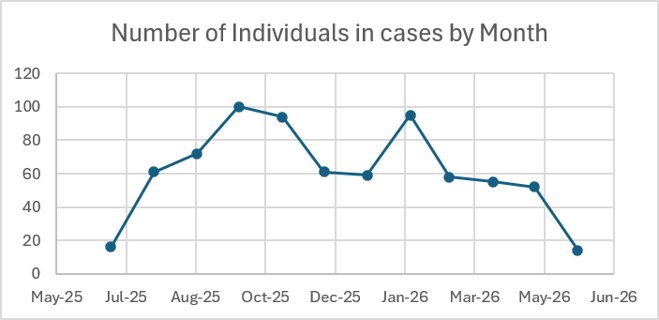
During the reporting period, SCCS supported 726 individuals through a variety of processes and services. The scope of the office’s work extended
beyond formal conduct matters and included academic integrity concerns, student conduct
cases, educational conversations, advocacy, referrals, consultations, and collaboration
with campus partners. These efforts demonstrate the broad role SCCS plays in supporting
both individual students and the larger university community.
A significant portion of SCCS’s work involved responding to concerns through educational
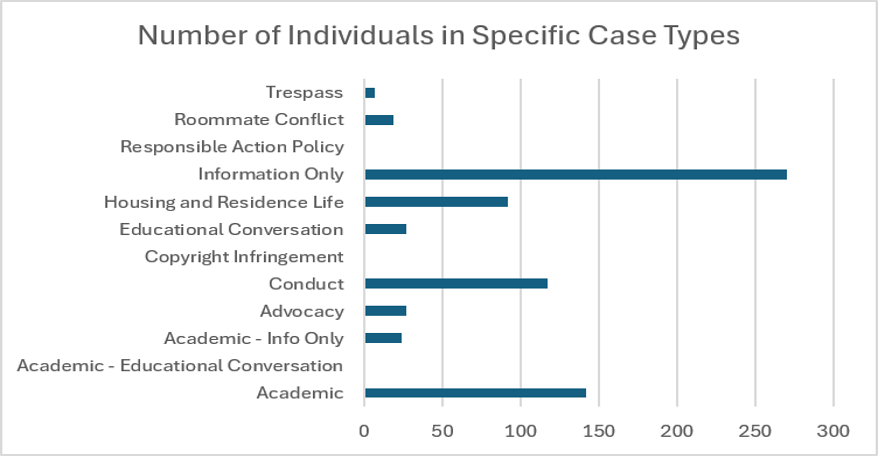
and supportive approaches. The office managed 270 Information Only matters, which included reports, consultations, referrals, and situations requiring documentation
or follow-up. SCCS also facilitated 27 Educational Conversations and supported 27 advocacy cases, providing students opportunities to address concerns through communication, reflection,
and connection to appropriate resources.
SCCS also partnered with campus departments to address a variety of student concerns,
including 92 Housing and Residence Life-related matters, 19 roommate conflict concerns, 7 trespass
matters, and 1 Responsible Action Policy case. Additionally, the office supported 166 academic integrity-related matters, including 142 academic cases and 24 academic information-only matters, as well as 117 student conduct cases involving potential violations of university expectations.
In addition to case management and student support, SCCS continued to prioritize communication
and student engagement throughout the reporting period. The office issued 1,131 official correspondence letters, with 872 letters retrieved by students and 259 letters not retrieved. These communications provided students with important information regarding processes,
expectations, and opportunities to engage with the office.
Through these efforts, SCCS continues to balance accountability with education by
providing fair and consistent processes, supporting student learning, and collaborating
with campus partners to promote a positive university environment. The office remains
committed to helping students navigate challenges while encouraging responsible decision-making
and meaningful growth.
Academic Integrity Policy 2.17
Academic integrity remained a significant area of responsibility for Student Conduct and Community Standards (SCCS) during the reporting period. SCCS supports the university’s commitment to maintaining academic standards through the administration of Policy 2.17 Academic Integrity while ensuring students involved in academic integrity concerns are provided a fair, consistent, and educational process. Through collaboration with faculty members, academic departments, and the Academic Integrity Committee, SCCS works to uphold academic expectations while providing students opportunities for reflection, accountability, and growth.
During the reporting period, SCCS managed 166 academic integrity-related matters, including 142 academic cases and 24 academic information-only matters. The majority of academic integrity cases were resolved through the Accepted Sanctions process, with 122 cases resolved through this pathway. This process allows students to acknowledge responsibility and participate in appropriate educational outcomes while maintaining an efficient and consistent resolution process. Additionally, 10 cases were referred to the Academic Integrity Committee for formal review.
Of the cases reviewed by the Academic Integrity Committee, 2 cases resulted in an
In Violation finding and 8 cases resulted in a Not In Violation finding.
Academic Colleges
Academic integrity concerns occurred across multiple academic areas, demonstrating
the university-wide importance of maintaining academic standards. The College of Engineering had the highest number of reported cases with 38, followed by Fairmount College of Liberal Arts and Sciences with 35, College of Health Professions
with 21, and the Barton School of Business with 20. Additional cases were reported within the Graduate School (19), College of Education/Applied Studies (16), College of Fine Arts
(9), and Unlisted academic areas (8).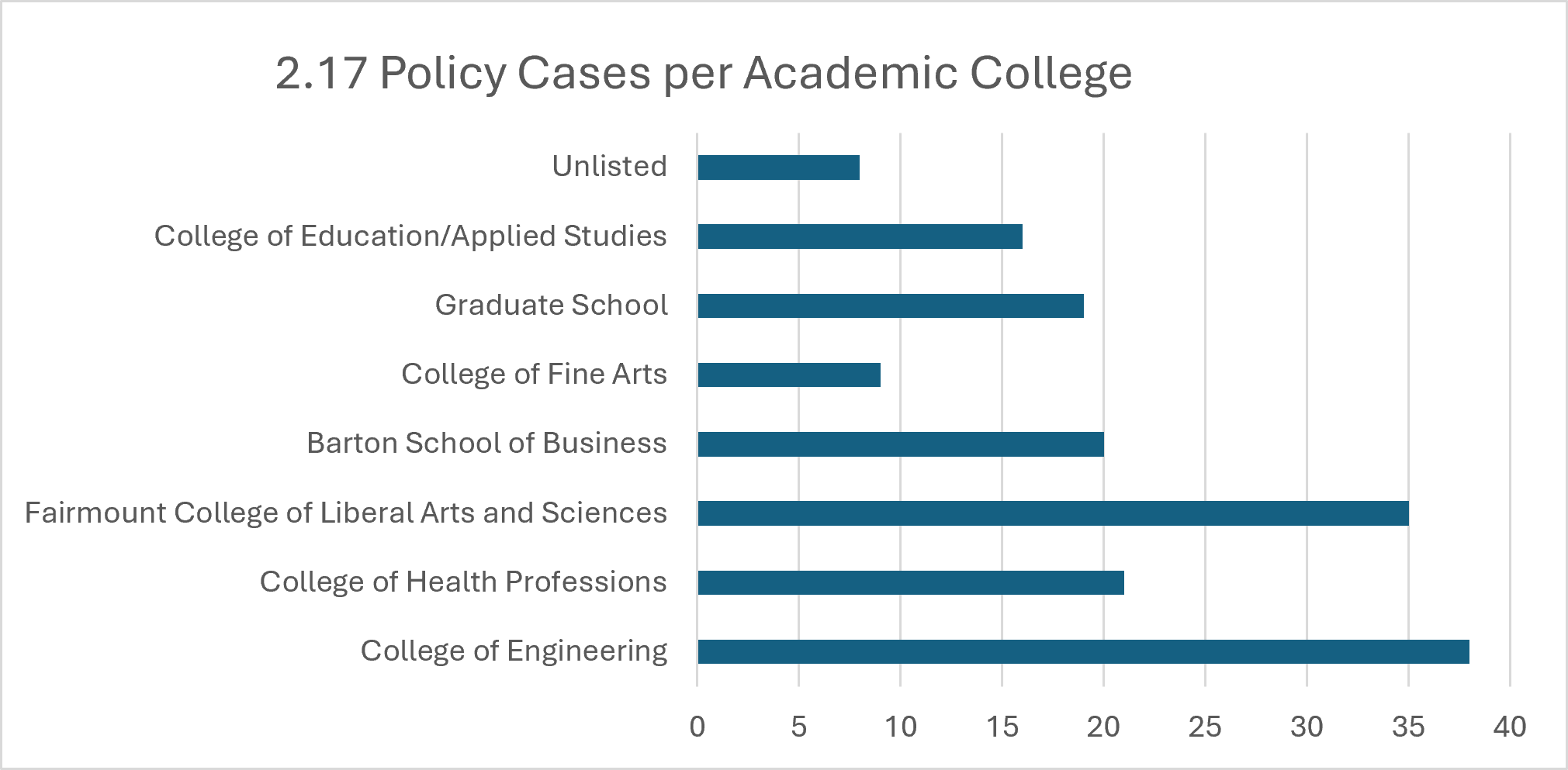
Academic integrity concerns involved students across all levels of enrollment. Seniors accounted for the highest number of cases with 52, followed by first-year students with 41, juniors with 31, and both sophomores and graduate students with 21 cases each. Academic integrity cases involved both domestic students (129) and international students (37), demonstrating the importance of continued academic integrity education and support throughout the university community.
The types of academic integrity concerns addressed by SCCS reflected a range of behaviors
impacting academic standards. The most frequently identified concerns involved unauthorized use or possession of materials/resources (60 cases), plagiarism (50 cases),
artificial intelligence-related concerns (46 cases), unauthorized collaboration/consultation
(35 cases), and fabrication, falsification, or misrepresentation of information (29 cases). Additional concerns included facilitation of academic misconduct (6 cases), academic interference (5 cases), unauthorized
resubmission (4 cases), and unauthorized sale, distribution, or receipt of academic materials (1 case). These trends highlight the evolving nature of academic integrity concerns and the
continued need for education and partnership between SCCS, faculty, and students.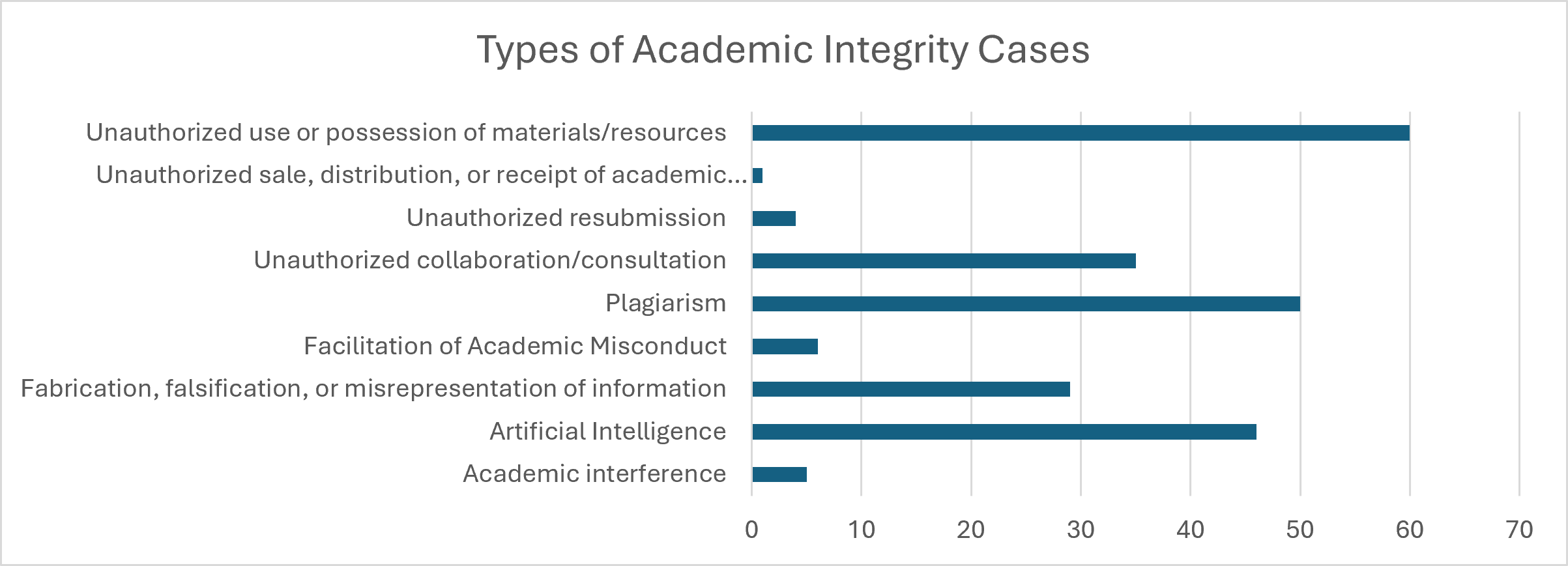
In addition to managing academic integrity cases, SCCS continued to focus on education
and prevention efforts. The office provided training to hearing board members and
committee participants to support consistent decision-making and understanding of
academic integrity procedures. SCCS also provided Academic Integrity 101 training
to promote awareness of university expectations and help students and campus partners
better understand the academic integrity process.
Through its academic integrity processes and educational initiatives, SCCS continues
to balance accountability with student development. The office’s approach focuses
not only on addressing concerns but also on helping students understand the importance
of academic honesty, ethical decision-making, and their role in maintaining the integrity
of the university’s academic community.
Student Code of Conduct Policy 8.05
Student Conduct and Community Standards (SCCS) administers Policy 8.05 Student Code
of Conduct, which establishes the behavioral expectations for Wichita State University
students and outlines the university's process for addressing alleged violations.
The conduct process is designed to promote accountability while supporting student
learning and development through fair, equitable, and educational practices. SCCS
strives to help students understand the impact of their decisions, repair harm when
appropriate, and develop the knowledge and skills necessary to contribute positively
to the university community.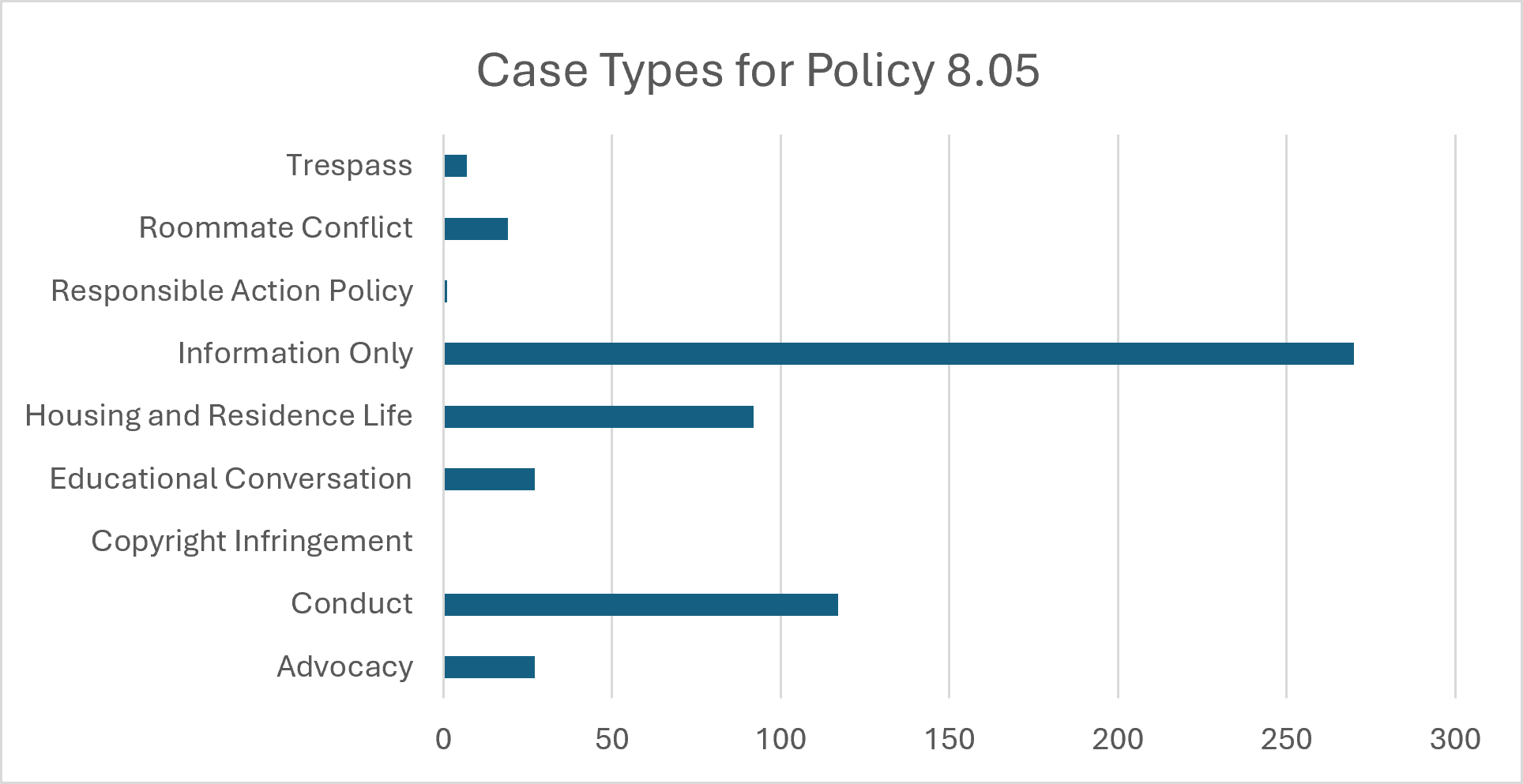
During the reporting period, SCCS managed 560 student conduct and community support-related
matters, reflecting the broad scope of the office's work beyond formal conduct cases.
While many matters involved alleged violations of the Student Code of Conduct, the
office also responded to a wide range of concerns through educational conversations,
advocacy, responsible action, documentation, and collaboration with campus partners.
The largest category of conduct-related work involved 270 Information Only matters, which included reports, consultations, referrals, and incidents requiring
documentation or coordination without progressing through the formal conduct process.
SCCS also facilitated 27 Educational Conversations, providing students with opportunities to address lower-level concerns through discussion,
reflection, and education. In addition, the office provided support through 27 advocacy matters, connecting students with campus resources and assisting them in navigating university
processes.
Collaboration with campus partners remained an important component of SCCS's work.
During the reporting period, the office managed 92 Housing and Residence Life-related matters, demonstrating the strong partnership between SCCS and Housing in responding to student
concerns and supporting residential communities. SCCS also addressed 19 roommate conflict matters, 7 trespass matters, and 1 Responsible Action Policy
case, reinforcing the office's commitment to maintaining a safe, respectful, and supportive
campus environment.
The most frequently identified policy charges addressed through SCCS processes reflected
a range of academic and behavioral concerns.
| 1 | VI.A.1 Academic Integrity |
| 2 | VI.B.1 Alcohol, Drugs, & Other Substances – Underage |
| 3 | VI.D.1. Disruptive Behavior - Failure to Comply |
| 4 | VI.D.5. Disruptive Behavior - Disruptive Behavior (General) |
| 5 | VI.B.9 Alcohol, Drugs, & Other Substances – Possession / Drugs |
These trends demonstrate the broad scope of SCCS’s work in addressing both academic and behavioral concerns while supporting students through fair and educational processes. SCCS continues to emphasize early intervention, accountability, and education to help students understand university expectations and make responsible decisions that contribute to a positive campus environment.
The conduct process is designed to provide outcomes that are educational, proportional,
and appropriate to the circumstances of each case. During the reporting period, SCCS
assigned a range of sanctions intended to promote accountability while supporting
student learning and success.
The most frequently assigned status sanctions were Disciplinary Warning (63) and Housing
Warning (47), reflecting the office's emphasis on addressing lower-level misconduct
through educational intervention and early accountability. Additional sanctions included
Disciplinary Probation (16) and Housing Probation (14) for students requiring a heightened
level of accountability and monitoring.
In cases involving more significant or repeated misconduct, SCCS assigned 2 suspensions
and 1 dismissal. No students were expelled during the reporting period. This distribution
of status sanctions reflects SCCS's commitment to utilizing the least restrictive
sanction appropriate to the circumstances while maintaining the safety of the university
community and encouraging student growth and responsible decision-making.
SCCS also utilized reflective and education sanctions including reflection papers,
and judicial educator modules.
Although formal conduct cases remain a core responsibility of the office, this data
demonstrates that SCCS's work extends well beyond adjudicating policy violations.
The office serves as a resource for students, faculty, staff, and campus partners
by providing guidance, consultation, educational interventions, and coordinated responses
that promote student success while upholding community standards.
Organizational Misconduct
Overview
Student Conduct and Community Standards (SCCS) continued to partner with Student Engagement,
Advocacy & Belonging (SE&B) to address concerns involving registered student organizations
(RSOs) during the reporting period. Organizational conduct matters often require a
collaborative approach that balances accountability with education while supporting
organizations in maintaining a safe, respectful, and inclusive campus environment.
During the reporting period, SCCS reviewed 11 organizational conduct matters involving registered student organizations and fraternities/sororities. Reported
concerns included allegations of hazing, harassment, bullying, organizational leadership concerns, unauthorized presence
in residence halls, alcohol-related behavior, and other conduct inconsistent with university expectations.
The majority of organizational matters were resolved through educational conversations
conducted in partnership with SE&B staff. These conversations provided organizational
leaders with an opportunity to review university expectations, discuss concerns, and
identify strategies to promote responsible leadership and reduce future risk. In situations
where reported information did not meet the threshold required to proceed through
the organizational conduct process, cases were closed after review in accordance with
university procedures.
Throughout the year, SCCS remained committed to responding promptly to reports involving
student organizations while collaborating with campus partners to assess concerns,
support affected students and encourage organizations to uphold the values and expectations
of Wichita State University. This collaborative approach emphasizes education, prevention,
and organizational accountability while helping foster a safe and welcoming campus
community.
- Navigators RSO
- Incident Date: 08/15/2025
- Incident Summary: “members of club in Shocker hall, no residents”
- Resolution: Educational Conversation with SE&B Staff
- Status: Case Closed
- Phi Delta Theta Fraternity
- Incident Date: 09/09/2025
- Incident Summary: “Beta Theta Pi is rewarding 5 members for having sex with the same lady by gifting products that cost a significant amount of money”
- Resolution: Educational Conversation with SE&B Staff
- Status: Case Closed
- Gamma Phi Beta Sorority
- Incident Date: 10/03/2025
- Incident Summary: “alleged issues within the chapter, including multiple members dropping due to bullying, executive members on probation, and biased behavior targeting specific individuals. Concerns were raised about mishandled rituals, poor leadership response to bullying, and significant financial debt”
- Resolution: Educational Conversation with SE&B Staff
- Status: Case Closed
- Sigma Alpha Epsilon Fraternity
- Incident Date: 11/01/2025
- Incident Summary: “reports hazing and harassment from Sigma Alpha Epsilon, Farm House, Beta Phi Delta”
- Resolution: Did not meet organization requirements
- Status: Case Closed
- Farmhouse Fraternity
- Incident Date: 11/06/2025
- Incident Summary: “reports hazing and harassment from Sigma Alpha Epsilon, Farm House, Beta Phi Delta”
- Resolution: Did not meet organization requirements
- Status: Case Closed
6. Beta Theta Phi Fraternity
-
- Incident Date: 11/06/2025
- Incident Summary: “reports hazing and harassment from Sigma Alpha Epsilon, Farm House, Beta Phi Delta”
- Resolution: Did not meet organization requirements
- Status: Case Closed
7. Sigma Phi Epsilon Fraternity
-
- Incident Date: 11/07/2025
- Incident Summary: “allegations of hazing”
- Resolution: Did not meet organization requirements
- Status: Case Closed
8. Delta Upsilon Fraternity
-
- Incident Date: 11/07/2025
- Incident Summary: “allegations of hazing”
- Resolution: Did not meet organization requirements
- Status: Case Closed
9. Delta Upsilon Fraternity
-
- Incident Date: 12/06/2025
- Incident Summary: “a fraternity hosted an official event with proper university registration.”
- Resolution: Educational Conversation with SE&B Staff
- Status: Case Closed
10. Formula One RSO
-
- Incident Date: 1/10/2026
- Incident Summary: “members of the Formula One refused to stop consuming alcohol on college property”
- Resolution: Individual charges, Educational Conversation with SE&B Staff
- Status: Case Closed
11. Alpha Kappa Alpha
-
- 04/13/2026
- Incident Summary: “allegations of hazing”
- Resolution: Conversation with SE&B Staff
- Status: Case Closed
Conclusion
Throughout the reporting period, Student Conduct and Community Standards (SCCS) continued
to support the Wichita State University community through a balanced approach to accountability,
education, and student development. The work of the office extended beyond responding
to policy violations and included providing educational opportunities, supporting
students through challenging situations, collaborating with campus partners, and promoting
a culture of integrity and respect.
The data presented in this report reflects the broad scope of SCCS’s work, including
academic integrity processes, student conduct resolution, organizational conduct,
educational conversations, advocacy, and campus partnerships. Each interaction represents
an opportunity to help students understand expectations, reflect on their choices,
and develop the skills necessary to be successful members of the university community.
Moving forward, SCCS remains committed to continuously evaluating and improving its
processes, strengthening partnerships across campus, and providing fair and consistent
responses to student concerns. Through continued education, proactive outreach, and
thoughtful engagement, SCCS will continue to support a campus environment where students
are encouraged to learn, grow, and contribute positively to the Wichita State community.